Introduction: The Ladder Fear is Real
We’ve all had that moment of “ladder vertigo.” For me, it usually happens when I’m trying to reach that one stubborn cobweb in the high corner of the entryway. My two boys are playing tag around the base of the ladder. It’s a recipe for disaster.
You don’t need to risk a fall to have sparkling second-story glass. The secret used by professionals isn’t a taller ladder; it’s a better reach. Today, I’m showing you how to reclaim your high-reach windows .
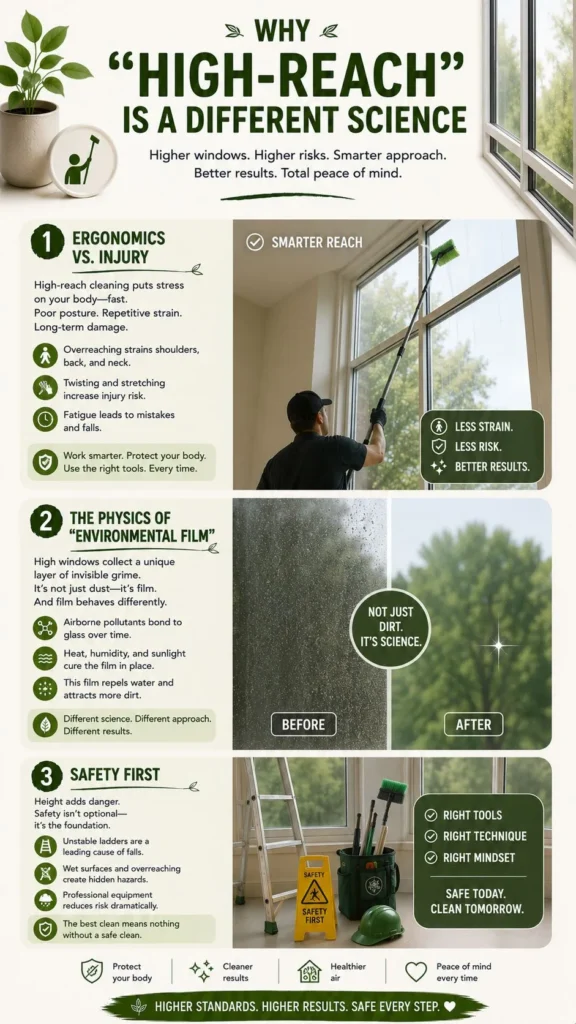
Why “High-Reach” is a Different Science
In my dietician practice, I often talk about ergonomics and how we move our bodies. Cleaning high windows isn’t just about length; it’s about leverage and physical strain.
Here is why high-reach glass requires a specialized approach:
- Ergonomics vs. Injury: Reaching awkwardly with a heavy, unbalanced pole can lead to shoulder and neck strain. I look for tools that are lightweight (aluminum or carbon fiber) so I can maintain my posture while working.
- The Physics of “Environmental Film”: High-exterior windows are the first to catch pollen, bird droppings, and vehicle exhaust. Because they are harder to reach, this “film” often sits longer and bonds more deeply to the glass.
- Safety First: As a health professional, I look at the “risk vs. reward.” Using a telescopic pole keeps your center of gravity on the floor, which is the only place a busy mom should be when the house is full of energy.
Extension Poles vs. Water-Fed Poles: Which is Right for You?
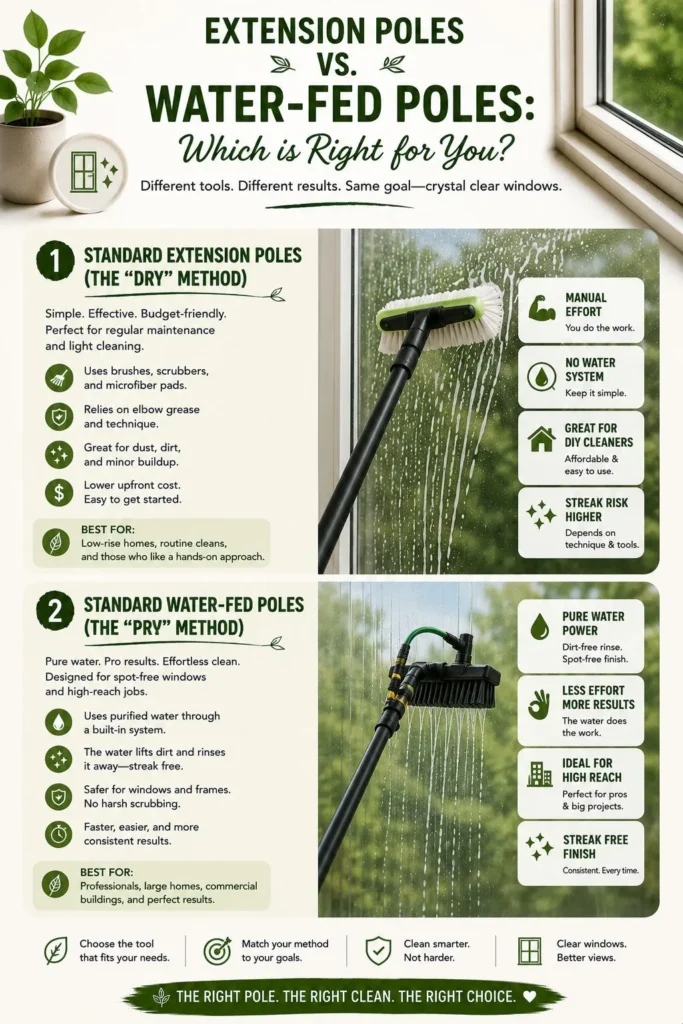
Choosing the right pole is about matching the tool to the specific “problem” your windows are facing. As a dietician, I compare this to choosing the right kitchen appliance—you wouldn’t use a blender when you need a food processor!
- Standard Extension Poles (The “Dry” Method): These are essentially long, sturdy sticks that you attach your squeegee or microfiber scrubber to. They are perfect for interior high windows (like entryways or lofts) where you don’t want water spraying everywhere. You apply the solution to the pad, scrub, and then squeegee it off manually.
- Water-Fed Poles (The “Pro” Method): These poles connect directly to your garden hose. Water flows through the pole and out of a brush head. This is the gold standard for exteriors. It allows you to scrub away bird droppings and pollen while a constant stream of water rinses the glass crystal clear. Because you’re using a constant rinse, you often don’t even need to squeegee afterward!
Recommended High-Reach Tools
To get that professional finish without the “ladder lean,” you need a pole that is both rigid and lightweight. Here are my top picks for keeping your feet on the ground:
The Professional Window Wiper with 190 cm Extension is an ideal choice for interior cathedral windows or high mirrors. The pivot head is the standout feature here—it allows you to maintain the perfect squeegee angle even when you’re standing directly below the window. Plus, it’s designed to minimize drips, which is a lifesaver for your hardwood floors.
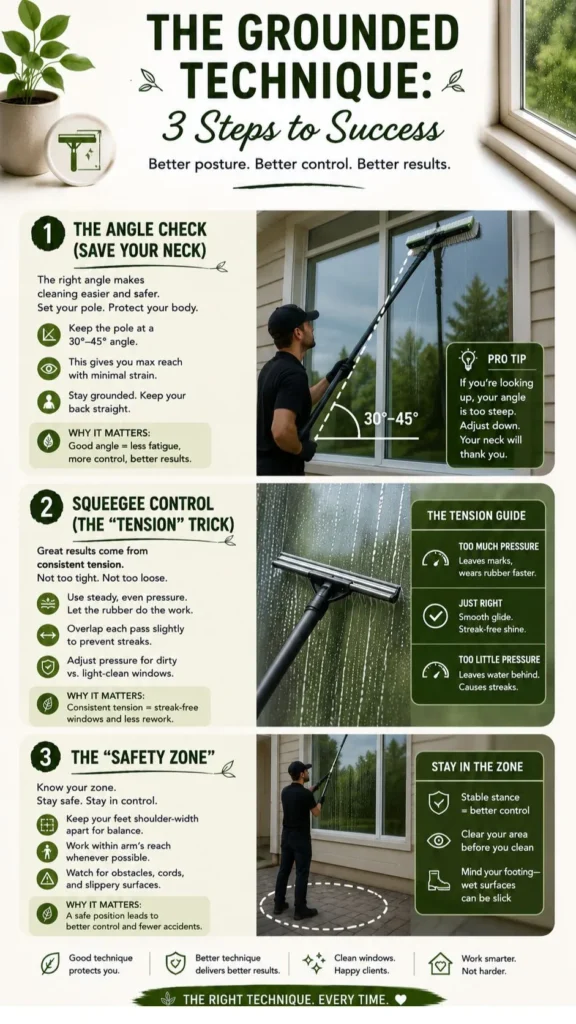
The Grounded Technique: 3 Steps to Success
Cleaning with a 15-foot pole is very different from cleaning by hand. As a dietician, I focus on functional movement—using your large muscle groups so you don’t wake up with a sore neck the next day.
- The Angle Check (Save Your Neck): Never stand directly underneath the window you are cleaning. Not only will you get “rain” on your face, but it strains your cervical spine. Stand 3–5 feet back so you can look at the glass at a comfortable angle.
- Squeegee Control (The “Tension” Trick): The secret to a streak-free finish at a distance is consistent pressure. I teach a “top-down” stroke where you let the weight of the pole do most of the work. Don’t fight the pole; guide it.
- The “Safety Zone”: Before you extend that pole, make sure the “landing zone” is clear. I always make sure my boys are playing in the backyard or another room. A telescopic pole is a professional tool, and we want to ensure no little feet (or paws!) are in the way of a stray drip or a moving pole.
Conclusion: Professional Results, Zero Scratches
There is a certain peace of mind that comes from knowing you can maintain your home’s exterior without ever risking a trip to the ER. As a dietician and a mom, I’ve learned that the best health strategy is prevention—and that applies to falls just as much as it does to nutrition.
By investing in a high-quality telescopic system, you’re not just buying a cleaning tool; you’re buying safety and independence. You can have the brightest, clearest view in the neighborhood while keeping your feet exactly where they belong: firmly on the ground.
Ready to build your kit? Check out my Window Vacuum vs. Squeegee guide to see which head attachment you should pair with your new extension pole!