⚡ Direct Answer: How to Lubricate Sliding Glass Door Tracks Without Attracting Dirt?
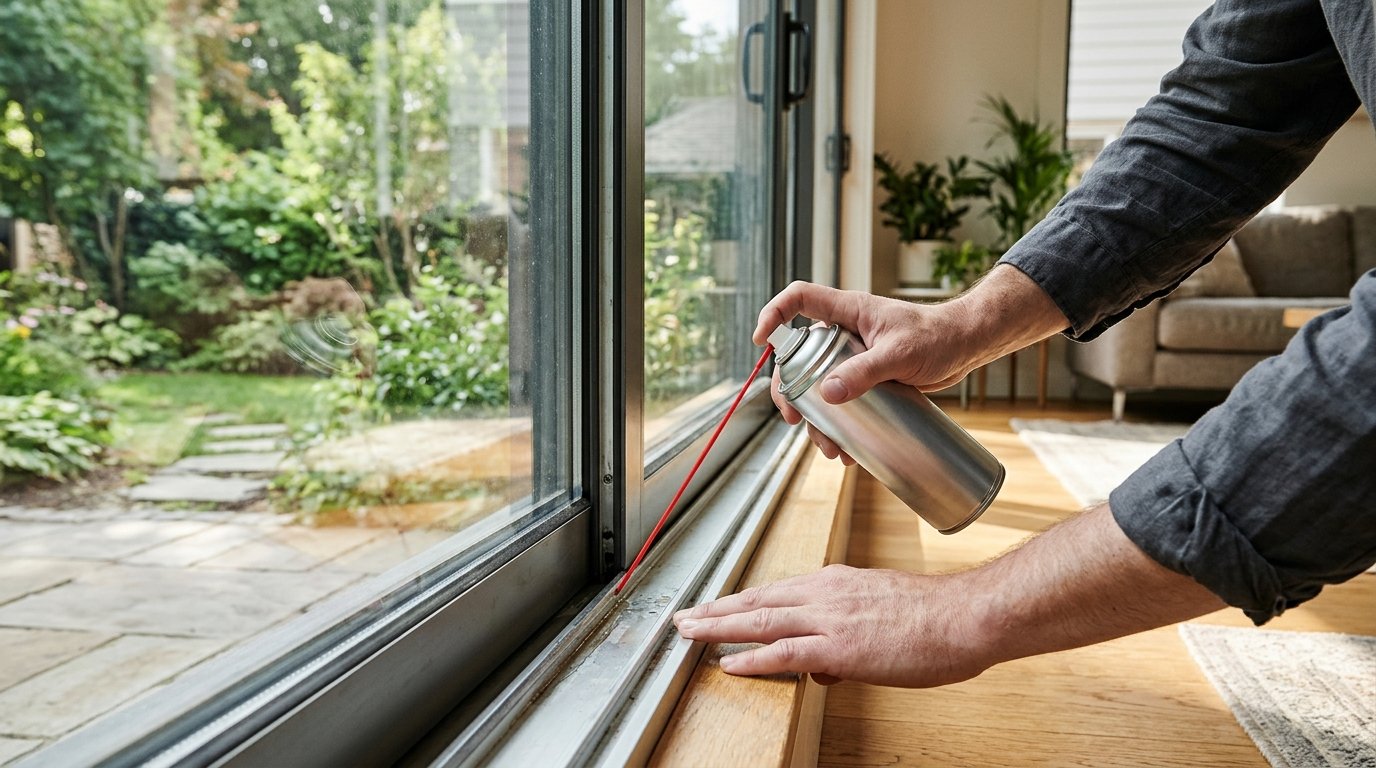
To lubricate sliding glass door tracks without attracting dirt, never use petroleum grease, motor oil, or standard multi-use WD-40. First, dry-vacuum all loose sand and debris out of the track channels. Second, wipe the aluminum rails clean with a 50/50 mixture of warm water and white vinegar, drying thoroughly with a lint-free microfiber cloth. Third, spray a dry PTFE (Teflon) spray or dry silicone lubricant along the raised guide rail and into the lower roller adjustment access holes using a precision straw nozzle. The carrier solvent evaporates in 3 to 5 minutes, leaving a slick, completely dry micro-barrier that repels dust, pet hair, and abrasive grit.
When a heavy patio sliding glass door begins to shudder, screech, or require two hands and a running start just to slide open, almost every homeowner reaches for the familiar blue-and-yellow can of multi-purpose WD-40 sitting on their garage workbench. They generously soak the metal track, slide the door back and forth twice, and celebrate a temporary fix.
Within two to three weeks, however, celebration turns into a homeowner nightmare. The wet petroleum oil acts like flypaper, grabbing windblown garden dust, pet shedding, pollen, and abrasive sidewalk sand. Combined with daily foot traffic, this mixture churns into a thick, gritty black grinding paste that wears flat spots onto nylon rollers, chews grooves into the aluminum threshold rail, and permanently seizes the sliding door mechanism.
Sliding glass doors weigh between 75 and 150 pounds and rely on precision ball-bearing rollers riding along a raised metal rib. If you want your patio doors to glide effortlessly with the nudge of a single finger, you need to understand the physics of clean friction reduction. Here is our master guide on how to lubricate sliding glass door tracks without attracting dirt, featuring professional dry lubricants, roller height tuning, and a 4-phase maintenance protocol.
Why Standard Oils and Grease Destroy Sliding Doors
Before applying dry PTFE spray, ensure all embedded pet fur and gritty soil are removed. Follow our deep extraction tutorial in how to clean sliding door tracks with caked dog hair and sand.
🪟 Lubrication Not Fixing a Stuck Sliding Window Sash?
If dry PTFE spray still doesn’t release a grinding window sash, your nylon wheels have likely collapsed or developed flat spots. Learn how to replace sliding window track rollers cleanly in 30 minutes.
Before spraying anything into your door track, it is critical to understand why traditional lubricants fail so catastrophically on sliding patio doors:
⚡ Metal Track Rough or Covered in White Powder?
If your door catches because of pitted corrosion rather than dirt, ordinary degreasers won’t fix it. Follow our step-by-step restoration guide on how to clean oxidized aluminum window tracks to dissolve white chalky residue before applying your dry PTFE lubricant.
- The “Flypaper” Effect of Wet Oils: Standard penetrating oils (like original multi-use WD-40), motor oil, and 3-In-One oil never dry. They remain wet and tacky indefinitely. Patio thresholds are situated at ground level where exterior wind, outdoor pets, and human shoes constantly deposit dry soil and pine needles. The wet oil immediately captures these particles, creating an abrasive slurry.
- Chemical Softening of Nylon Rollers: The vast majority of modern sliding patio doors manufactured in the last thirty years use nylon or Delrin polymer wheel rollers, not steel wheels. Petroleum distillates chemically soften and degrade nylon over time, causing the rollers to develop flat spots or crack under the weight of the double-glazed glass unit.
- Aluminum Track Abrasion: Once grit mixes with grease, it acts like 80-grit sandpaper under the wheels. Every time you slide the door open, the heavy rollers press that sand into the soft aluminum guide rail, grinding irreversible dips and ruts into the metal. Once the rail is deeply gouged, no amount of lubricant will ever make the door slide smoothly again.
⚠️ Products to NEVER Spray on Patio Door Tracks
- Original Multi-Use WD-40: It is a water-displacing solvent with light mineral oil, not a heavy-duty sliding lubricant. It evaporates rapidly and leaves a sticky residue.
- Lithium Grease or Axle Grease: Thick white lithium grease is meant for sealed automotive joints; in an open residential door track, it turns into disgusting black sludge within days.
- Cooking Spray (Pam / Vegetable Oil): Organic oils quickly oxidize, turn rancid, become tacky, and attract outdoor ants and fruit flies.
The Best Clean Lubricants for Sliding Tracks
Applying dry lubricants to articulated window hinges instead of sliding doors? Read our step-by-step procedure for scissor linkages in how to clean casement window hinges and tracks.
To achieve frictionless sliding without creating a dirt trap, professional window and door installers exclusively use dry-film lubricants. Here are the top two choices:
1. Dry PTFE (Teflon) Spray (The Gold Standard)
Polytetrafluoroethylene (PTFE) has one of the lowest coefficients of friction of any solid known to engineering. When sprayed from an aerosol can, it goes on wet with a fast-evaporating solvent carrier that penetrates deep into roller ball bearings. Within 3 minutes, the solvent completely flashes off, leaving behind a microscopic, paper-dry white fluoropolymer film. It is completely non-greasy, 100% dry to the touch, and physically impossible for dirt, sand, or dog hair to stick to.
2. Dry High-Performance Silicone Spray
A dedicated quick-drying silicone spray is an excellent alternative, particularly in coastal or humid regions prone to aluminum oxidation. Make sure the can explicitly states “Dry Film” or “Fast Drying”. It forms a slick, waterproof, transparent film that repels moisture and prevents sliding chatter.
🛠️ Tools & Materials Needed
- Dry PTFE Lubricant Spray: (e.g., WD-40 Specialist Dry Lube with PTFE or DuPont Teflon Non-Stick Dry-Film).
- Vacuum with Narrow Crevice Attachment: Crucial for removing dry abrasive grit before cleaning.
- Stiff-Bristle Detail Cleaning Brush or Old Toothbrush: For scrubbing corners.
- Distilled White Vinegar & Warm Water: Non-toxic degreasing wash (from our master window track cleaning guide).
- Microfiber Cloths: Lint-free rags for wiping the rails bone-dry.
- Phillips Head Screwdriver: For tuning bottom roller height adjustment screws.
WD-40 Specialist Dry Lube with PTFE Anti-Friction Spray
Dries clear in under 3 minutes with zero oily residue. Formulated with pure PTFE to resist dust, dirt, and pet hair build-up on residential sliding doors.

Step-by-Step: The 4-Phase Clean Lubrication Protocol
The Golden Rule of Track Lubrication: Never apply lubricant onto a dirty track! Spraying dry PTFE onto sand and dead bugs simply seals the abrasive particles beneath a slick polymer skin. Always execute these four phases in order.
Phase 1: Dry Vacuum Extraction
Slide the door completely open to one side. Take your vacuum cleaner with the narrow crevice wand attachment and thoroughly suck out all loose debris. Pay particular attention to the far corners and the exterior threshold lip where garden gravel tends to nestle. (If you own heavy-shedding dogs or cats whose fur wraps around the track rollers, read our dedicated trick in how to get dog hair out of sliding door tracks).
Phase 2: Scrub Away Old Grease & Sludge
If someone previously applied oil or grease, you must dissolve that gummy residue before applying dry PTFE:
- Mix 1 cup of warm water with 1 cup of distilled white vinegar and 2 drops of Dawn dish soap.
- Spray the solution generously along the metal track. Allow it to sit for 2 minutes to break down oxidized oily films.
- Use a stiff toothbrush or a custom-cut sponge (see our viral technique in how to clean window tracks with a sponge) to scrub along the raised center guide rail.
- Wipe the dirty slurry out completely with clean microfiber cloths until the bare aluminum or vinyl shines.
- Ensure Complete Dryness: Wait 5 to 10 minutes or use a dry rag to ensure zero standing moisture remains in the track crevices.
Phase 3: Precision Application of Dry PTFE Spray
- Shake your can of Dry PTFE spray vigorously for 30 seconds to suspend the microscopic fluoropolymer particles in the liquid carrier.
- Insert the thin red applicator straw into the spray nozzle for surgical precision.
- Hold the straw roughly 1 inch away from the raised center guide rail (the narrow metal ridge that the wheels roll directly on top of).
- Spray a light, even bead along the entire length of the rail from one end to the other. You do not need a thick puddle—a thin mist is more effective.
- Also apply a light burst along the top head-jamb channel where the top guide guides slide. (If your companion screen door is jumping off its track, apply this same treatment following how to clean sliding screen door tracks).
- Wait 3 to 5 minutes! Do not move the door immediately. Allow the liquid carrier to fully evaporate into a bone-dry, chalk-like transparent film.
Phase 4: Lubricating & Tuning the Internal Wheel Rollers
The track rail is only half the equation; the door’s weight actually rests on two adjustable roller assemblies housed inside the bottom frame rail of the glass door.
- Look at the very bottom exterior or interior corners of your sliding door panel. You will see small rubber plugs or circular access holes roughly 1/2 inch from the floor.
- Pop off the plastic caps using your fingernail or a flat blade.
- Insert the applicator straw directly into the access hole, aiming toward the wheel bearing inside the bottom rail.
- Give a firm 2-second burst of dry PTFE spray to lubricate the internal axle and ball bearings.
- Repeat on the opposite bottom corner access hole.
- Slide the door back and forth 5 to 6 times. You will immediately feel the door glide silently with effortless momentum.
🔧 Pro Secret: Adjusting Roller Height (Fixing a Dragging Door)
If your sliding door still scrapes along the metal bottom track after cleaning and lubricating, the rollers have collapsed downward due to gravity. Over years of use, the adjustment screws vibrate loose, lowering the door until the bottom aluminum frame rubs directly against the threshold.
- Insert a #2 Phillips head screwdriver into the bottom corner access hole. Feel for the screw head inside the cavity.
- Turn the screw clockwise to raise the door panel up, lifting it away from the bottom track. Turn it counter-clockwise to lower it.
- Adjust both bottom corners equally until you see a uniform 1/4-inch reveal gap between the bottom of the door and the track.
- Check the door lock latch alignment to ensure the deadbolt meets the jamb keeper cleanly.
Seasonal Maintenance Schedule
To maintain silky smooth operation and protect your door tracks against long-term wear, follow this simple seasonal schedule:
- Twice a Year (Spring & Autumn): Perform the quick 5-minute dry vacuum and apply a fresh coat of dry PTFE spray along the raised rail.
- After Heavy Storms: Inspect exterior track weep slots to confirm rainwater drains freely and hasn’t left sediment behind (see our maintenance guide on how to clean weep holes in vinyl windows).
- High-Dust / Coastal Environments: If you live near desert sand or ocean salt spray, rinse the track with warm water once every 60 days to prevent salt crystal crusting before reapplying dry silicone.
Frequently Asked Questions
Can I use candle wax or paraffin wax on sliding glass door tracks?
Yes! Paraffin wax (such as household canning wax or an uncoloured tea candle) is an outstanding, 100% dry alternative for sliding doors, particularly on wooden sliding frames or vintage bypass doors. Simply rub the wax block vigorously along the top of the raised metal rail. The friction of the wheels spreads a micro-thin wax barrier that will never collect dirt or dog hair.
Why is my sliding glass door still hard to slide after lubricating?
If a door remains heavy and resistant after applying dry PTFE, the problem is mechanical rather than frictional. The internal steel ball bearings inside the wheel assemblies have either rusted solid, or the nylon wheels have developed severe flat spots from being dragged across sand. In this scenario, you do not need a new door—simply remove the door panel, unscrew the bottom roller cartridges, and replace them with universal $15 sliding patio door tandem rollers from your local hardware store.
Is silicone spray better than PTFE for sliding patio doors?
Both are excellent, but Dry PTFE provides slightly superior dirt resistance because it dries completely tack-free with zero oily residue. Standard wet silicone sprays leave a very faint oily sheen that can catch fine dust. If using silicone, always ensure the label specifically indicates “Fast Drying” or “Dry Film Lubricant”.
Pingback: How to Get Dog Hair Out of Sliding Door Tracks (Fast Paw-Safe Fix)
Pingback: How to Clean Window Tracks: Get Grime Out of Sliding Doors Easily