Few household annoyances are as grating as a sliding patio door or window sash that suddenly screeches, catches, and resists every attempt to glide open. You kneel down with a vacuum and a bottle of soap, expecting a simple layer of household dust, only to discover something far more stubborn: the smooth silver metal has turned into a rough, chalky white crust that feels like 80-grit sandpaper under your fingers.
That white powder is not dried mineral scale, nor is it standard mold or mildew. It is aluminum oxide—the byproduct of an electrochemical reaction between the aluminum alloy frame, atmospheric oxygen, trapped moisture, and airborne pollutants. While modern vinyl tracks wipe clean with soapy water, weathered aluminum tracks corrode over time, seizing roller wheels, chewing up nylon guides, and ruining the aesthetic lines of your home.
💡 Direct Answer: How to Clean Oxidized Aluminum Window Tracks
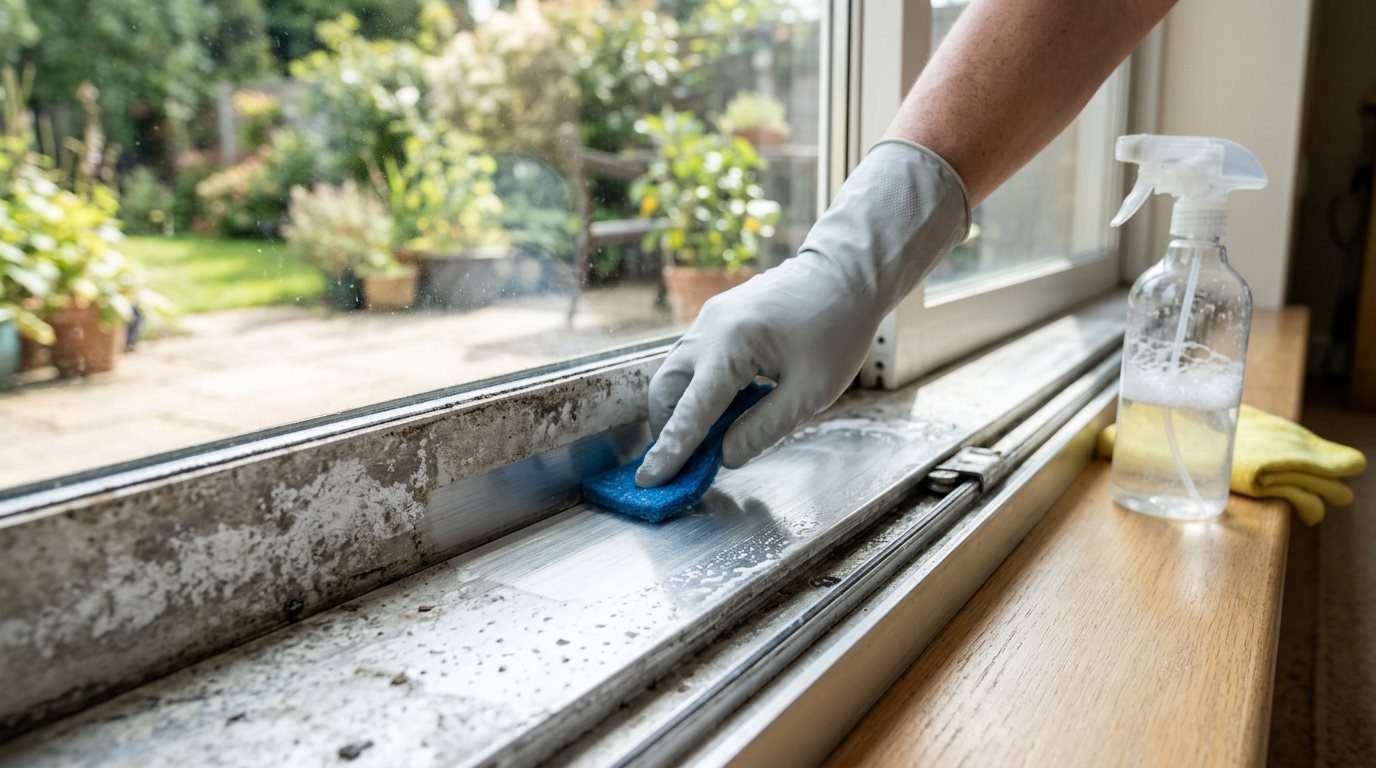
To clean oxidized aluminum window tracks and dissolve white chalky powder without scratching the metal:
- Vacuum loose debris: Use a crevice attachment to remove all dry sand, hair, and grit.
- Apply a mild acid solution: Spray a 1:1 mixture of distilled white vinegar (5% acetic acid) and warm water, or lay vinegar-soaked paper towel compresses into the track for 15–20 minutes to dissolve aluminum oxide bonds. For heavy crust, apply a paste of Bar Keepers Friend (oxalic acid).
- Agitate along the grain: Scrub gently with a non-scratch nylon scouring pad or ultra-fine #0000 bronze/steel wool lubricated with the acid solution. Never use coarse steel wool or rotary wire brushes.
- Rinse and neutralize: Wipe thoroughly with a damp microfiber cloth soaked in fresh clean water (or a mild baking soda rinse) to halt acid reactivity.
- Dry and seal: Buff completely dry with microfiber, then coat the clean track with automotive carnauba paste wax or spray with dry PTFE (Teflon) lubricant to create a protective barrier against moisture re-oxidation.
Looking for everyday track maintenance instead of heavy metal restoration? If your tracks only have surface dirt, read our step-by-step guide on how to clean window tracks with a cut sponge.
Have modern black anodized or powder-coated sashes rather than raw silver aluminum? Read our specialized tutorial on how to clean black aluminum window frames to eliminate white UV chalking without bleaching dyed finishes.
The Science: Why Aluminum Window Tracks Turn White and Chalky
⚙️ Still Hearing Grinding After Deoxidizing Your Aluminum Track?
Aluminum oxide grit often shreds bottom sash wheels into flat-spotted bearings. Follow our step-by-step mechanical guide on how to replace sliding window track rollers without breaking the glass.
Unlike ferrous metals like carbon steel and iron, which react with moisture to produce iron oxide (flaking reddish rust that eats away structural integrity until the metal fails), aluminum has a self-protecting characteristic. When raw aluminum is exposed to air, it instantly bonds with oxygen molecules to form a microscopic passivation film of aluminum oxide (Al2O3):
4Al + 3O2 → 2Al2O3
In ideal, dry environments, this natural oxide shield is only a few nanometers thick, transparent, and impervious to air. However, sliding window tracks and patio door thresholds are rarely ideal environments:
- Trapped Condensation & Standing Water: Rainwater and glass condensation run down interior window panes and puddle in the bottom track. If exterior weep holes become clogged with silt, that standing water remains trapped for days, triggering continuous galvanic corrosion.
- Airborne Acid Rain & Coastal Salt: Sulfur dioxide from industrial emissions and airborne sodium chloride from ocean spray turn standing water into an aggressive electrolyte that breaks down the smooth anodized surface, forming rough craters and white efflorescent blooms.
- Alkaline Runoff: Dust from nearby brick mortar, concrete driveways, or stucco carries a high pH (9.0–12.0). When combined with rainwater, alkaline runoff attacks aluminum relentlessly.
The result is a rough, powdery crust that builds up along the sliding channel, gripping roller bearings, stripping weatherstripping, and turning what should be a smooth two-finger slide into a two-handed wrestling match.
Chemical Safety Matrix: What Restores vs. What Destroys Aluminum
Before grabbing cleaning products from under your sink, understand that aluminum is an amphoteric metal—it reacts aggressively with both strong acids and strong alkalis. Using the wrong chemical will turn your aluminum permanently black, pit the frame beyond repair, or dissolve the metal entirely.
| Cleaner / Chemical | Chemical Class | pH Level | Safety on Aluminum | Effect on Metal & Oxidation |
|---|---|---|---|---|
| Distilled White Vinegar | Acetic Acid (5%) | ~2.5 | Safe & Effective | Dissolves chalky oxide without harming base metal; ideal daily DIY restorer. |
| Lemon Juice / Citric Acid | Citric Acid (5–8%) | ~2.2 | Safe & Effective | Breaks down oxide crust and chelates surface minerals; pleasant natural scent. |
| Bar Keepers Friend | Oxalic Acid + Feldspar | ~1.5–2.0 | Safe (Short Dwell) | Superior ion-chelating action for heavy pitting; max 2–3 min contact time. |
| Baking Soda Paste | Sodium Bicarbonate | ~8.3 | Safe (Gentle Buff) | Mild non-scratch abrasive (Mohs 2.5); neutralizes acids and polishes surfaces. |
| Dawn Ultra Dish Soap | Anionic Surfactant | ~7.0–8.0 | 100% Safe | Lifts oily road film, pollen, and pet grease prior to chemical deoxidation. |
| Chlorine Bleach | Sodium Hypochlorite | ~11.0–13.0 | NEVER USE | Causes immediate electrochemical pitting and permanent black/gray chemical burning. |
| Oven Cleaner / Lye | Sodium Hydroxide | ~13.0–14.0 | CATASTROPHIC | Violently dissolves aluminum metal, releases flammable hydrogen gas, and ruins frames. |
| Muriatic Acid | Hydrochloric Acid | <1.0 | NEVER USE | Severely etches metal, strips factory anodized coats, and creates permanent deep pits. |
| WD-40 Multi-Use | Solvent Petroleum | N/A | Avoid on Tracks | Leaves sticky petroleum residue that attracts dirt; use dry PTFE spray instead. |
Essential Tools and Materials Checklist
To safely restore oxidized tracks without dulling surrounding woodwork or scratching adjacent glass, assemble these supplies:
- Vacuum with narrow crevice wand: For extracting loose grit, insects, and dried pet dander before introducing moisture.
- Chemical deoxidizer: Standard 5% distilled white vinegar or powdered Bar Keepers Friend (oxalic acid).
- Mechanical scrubbers: Non-scratch nylon Scotch-Brite pads (blue or white; never heavy-duty green on delicate finishes) or Grade #0000 ultra-fine bronze wool. Bronze wool is superior to steel wool because stray fibers will never rust.
- Detailing tools: A stiff-bristle nylon grout brush, an old toothbrush, and wooden bamboo skewers (essential for picking hardened crust out of 90-degree channel corners without gouging metal).
- Absorbent compresses: Heavy-duty shop towels or microfiber cloths.
- Protective barrier: Automotive carnauba paste wax or a specialized dry PTFE anti-friction spray.
- Personal protection: Nitrile gloves and safety eyewear.
Step-by-Step: The 5-Phase Aluminum Track Deoxidation Protocol
Follow this exact sequence to dissolve white powder, smooth out rough pitting, and seal the bare metal against moisture return.
Phase 1: Dry Vacuuming & Weep Hole Inspection
Never apply liquid cleaners to a dry, gritty window track. Loose sand, outdoor quartz particles, and pet hair turn into an abrasive slurry when wet, grinding micro-grooves into soft aluminum alloy.
- Attach a narrow crevice tool to your shop vac or household vacuum and run it along the full length of the track channel.
- Use a dry nylon detailing brush to sweep hardened sand and dead bugs out of deep corners directly into the vacuum nozzle.
- Inspect the exterior weep holes on the outer edge of the frame. Push a plastic pipe cleaner or zip tie through each opening to ensure rinse water will drain freely to the exterior rather than backing up into your interior subfloor.
Phase 2: Alkaline Degreasing Pre-Wash
Oxidized aluminum is frequently coated in a thin, invisible layer of road grime, airborne cooking oils, and pollen. Acids cannot dissolve aluminum oxide if an oily barrier prevents direct surface contact.
- Mix 1 tablespoon of Dawn Ultra dish soap into 1 quart of warm tap water.
- Dip a nylon detailing brush into the soapy solution and scrub the entire track vigorously.
- Wipe away the greasy foam with a damp microfiber cloth. You will now clearly see the bare, white chalky oxidized areas and rough pitted patches.
Phase 3: Chemical Acid Softening (The Dwell Phase)
Chemical reactions require contact time (dwell time). Simply spraying vinegar and wiping it off instantly accomplishes almost nothing. Use one of these two proven contact methods depending on the severity of the oxidation:
Method A: The Paper Towel Vinegar Compress (Moderate Oxidation)
- Fold heavy-duty paper towels into narrow strips that match the exact width of your window track.
- Saturate the strips in straight 5% distilled white vinegar and press them firmly into the channel, ensuring complete contact with all oxidized walls and bottom runners.
- Allow the compresses to sit undisturbed for 15 to 20 minutes. The acetic acid will gently break down the ionic bonds of the aluminum oxide crust without etching the base metal.
Method B: The Bar Keepers Friend Slurry (Heavy, Pitted Crust)
- If the track has thick, calcified white crust or rough craters, mix Bar Keepers Friend powder with a small amount of warm water in a small dish to form a thick, toothpaste-like slurry.
- Spread the paste evenly over the oxidized metal using an old toothbrush.
- Allow a maximum dwell time of 2 to 3 minutes. Oxalic acid is a rapid metal-chelating agent—never let it dry completely on bare aluminum.
Phase 4: Non-Scratch Mechanical Agitation
Once the acid has softened the crust, mechanical friction is needed to lift the loosened oxide particles away from the metal substrate.
- Remove the compresses. Re-spray the area lightly with vinegar to maintain continuous liquid lubrication.
- Take a non-scratch nylon scrubbing pad (blue Scotch-Brite) or a pad of #0000 ultra-fine bronze wool.
- Scrub strictly in a back-and-forth linear motion parallel to the window track. Never scrub in circular swirls. Aluminum has a distinct extrusion grain; scrubbing parallel to that grain blends fine micro-textures and preserves a clean, brushed-satin look.
- For the tight 90-degree inside corners where tracks meet the vertical frame, wrap a single layer of bronze wool over the flat tip of a wooden bamboo skewer or flathead screwdriver and press it firmly into the seam.
- Scrub until the white crust vanishes and the metal feels silky and smooth under a gloved fingertip.
Phase 5: Neutralization, Rinse & Microfiber Dry
This is the step most homeowners overlook, resulting in swift re-oxidation. Any residual acid left behind on freshly exposed, raw aluminum will continue to react with atmospheric oxygen, creating new white oxidation within 48 hours.
- Mix 1 tablespoon of baking soda into 2 cups of clean warm water to create a mild neutralizing rinse.
- Dip a clean microfiber cloth into the neutralizing solution, wring it out slightly, and wipe down every millimeter of the scrubbed track.
- Follow with a second microfiber cloth saturated in clean tap water to remove all baking soda salts.
- Immediately buff the entire track bone-dry using a plush, lint-free microfiber towel. Pay special attention to corners and roller tracks where moisture tends to pool.
Long-Term Protection: How to Seal Aluminum Tracks Against Re-Oxidation
Now that your aluminum tracks are pristine, smooth, and free of white residue, the bare aluminum alloy is in an unpassivated state—highly reactive and vulnerable to moisture. If left unsealed, airborne humidity and rain will cause white oxidation to return within weeks.
To lock in your restoration and guarantee a frictionless glide for 12 months or longer, apply one of these two professional protective barriers:
Option 1: Automotive Carnauba Paste Wax (Best for Window Frames & Sills)
Automotive paste wax (such as Collinite 845 or Meguiar’s Gold Class) creates a hard, hydrophobic, micro-crystalline barrier over raw aluminum that sheds condensation instantly:
- Apply a small dab of paste wax onto a foam applicator pad.
- Buff a thin, even coat into the aluminum track channel and over the interior frame lips.
- Let the wax haze for 5 to 10 minutes.
- Buff off the haze with a clean microfiber cloth. Rain and condensation will now bead up like water on a freshly waxed sports car rather than penetrating the metal.
Option 2: Dry PTFE (Teflon) Lubricant Spray (Best for Heavy Sliding Patio Doors)
If you are restoring the bottom track of a heavy sliding glass patio door, wax alone may wear down quickly under the immense friction of metal roller wheels. In our detailed guide on how to lubricate sliding glass door tracks, we explain why traditional wet lubricants like 3-in-One oil, grease, or standard WD-40 should never be used on sliding tracks: wet oils attract airborne sand, creating an abrasive grinding paste that seizes roller bearings.
Instead, spray a light, continuous coat of Dry PTFE Anti-Friction Spray directly along the raised center rail. Dry PTFE goes on wet, penetrates micro-crevices, and cures within 3 minutes into a 100% dry, clear, slick polymer film. Dust and dog hair cannot stick to it, while sliding rollers glide with virtually zero drag.
Restoring Different Frame Types: Anodized vs. Raw Mill Finish
Before scrubbing, it helps to understand what type of aluminum window frame you have:
- Anodized Aluminum (Bronze, Black, or Champagne Finish): Anodizing is an electrolytic passivation process that converts the surface into a durable, colored aluminum oxide layer. Warning: Never use abrasives stronger than a soft nylon cloth or mild vinegar on anodized frames, as aggressive scrubbing will break through the colored anodized layer, exposing silver aluminum underneath and causing permanent patchy discoloration.
- Mill-Finish Aluminum (Plain Silver Metal): Common in older 1970s–1990s homes, storm windows, and sliding screen doors. Mill finish is bare, raw metal without a protective factory barrier. It oxidizes quickly but can tolerate vigorous scrubbing with #0000 bronze wool and Bar Keepers Friend to achieve a gleaming polished look.
- Powder-Coated or Painted Aluminum: Modern windows often feature baked-on polyester powder coating (typically white, beige, or bronze). If white chalking appears on painted frames, it is usually paint oxidation rather than metal corrosion. Treat painted frames with a mild automotive paint cleaner/wax rather than metal acids. If old caulk is peeling along the edges, learn how to remove deteriorated silicone from glass and frames before resealing.
Preventative Maintenance Schedule
To avoid spending another afternoon on your hands and knees scrubbing heavy corrosion, implement this low-effort maintenance schedule:
| Frequency | Maintenance Action | Time Required | Benefit |
|---|---|---|---|
| Monthly | Dry vacuum tracks with crevice tool. | 2 Minutes | Removes dry grit before it scratches soft metal. |
| Quarterly | Wipe down tracks using the cut sponge track hack. | 5 Minutes | Lifts pollen and dust before it bonds with condensation. |
| Biannually (Fall & Spring) | Clear frame weep holes & apply fresh Dry PTFE spray. | 5 Minutes | Ensures proper drainage and frictionless sliding. |
| Annually | Inspect for early chalking; touch-up with vinegar & carnauba wax. | 10 Minutes | Prevents deep pitting and keeps tracks looking brand new. |
Frequently Asked Questions (FAQ)
Can I mix baking soda and vinegar together to clean aluminum tracks?
While mixing baking soda and vinegar creates a dramatic foaming reaction that looks impressive, it is chemically counterproductive for removing aluminum oxidation. Vinegar is an acid (pH 2.5) that dissolves aluminum oxide, while baking soda is a base (pH 8.3). When combined, they neutralize each other into carbon dioxide gas and water with sodium acetate, destroying the acid’s ability to dissolve oxide. Use vinegar first to dissolve the crust, and use baking soda afterward as a gentle physical buffer and neutralizer.
Will vinegar ruin or pit aluminum window tracks?
Standard household distilled white vinegar (5% acetic acid) will not damage aluminum when used with dwell times of 15 to 30 minutes. It is a weak organic acid that specifically dissolves the aluminum oxide coating without eating away structural metal. However, you should never leave vinegar sitting on aluminum for hours or overnight, and you must always rinse with fresh water once cleaning is complete.
Can I use WD-40 to clean and lubricate oxidized aluminum tracks?
Original WD-40 Multi-Use Product can help loosen seized metal parts in an emergency, but it should never be used as a regular track cleaner or lubricant. WD-40 contains petroleum distillates and light mineral oils that remain sticky. Within days, airborne dust, dog hair, and grit stick to the oily track, creating a black abrasive sludge that accelerates roller bearing failure. Always use a Dry PTFE Anti-Friction Spray instead, which cures to a dry, slick film that cannot attract debris.
Is #0000 steel wool safe to use on aluminum window frames?
Grade #0000 ultra-fine steel wool is soft enough that it will not scratch bare mill-finish aluminum. However, steel wool sheds microscopic carbon steel fibers during scrubbing. If these tiny steel particles are not 100% flushed out of the track, they will rust when exposed to moisture, leaving unsightly reddish-brown rust spots on your silver track. For this reason, #0000 bronze wool or blue non-scratch nylon pads are strongly preferred by restoration professionals.
Why did my aluminum track turn dark gray or black after cleaning?
If your aluminum turns dark gray or black, it was cleaned with a strong alkaline chemical such as chlorine bleach, ammonia, trisodium phosphate (TSP), or oven cleaner. Highly alkaline substances cause rapid chemical etching and deposit oxidation stains onto aluminum alloys. To reverse mild darkening, polish the metal with Bar Keepers Friend or a specialized aluminum metal polish (such as Mothers Mag & Aluminum Polish) using a microfiber towel.