Wake up on any freezing winter morning in a modern home, and you will likely find a familiar, frustrating sight along your bedroom or living room windows: thick streams of condensation trickling down the glass, pooling into deep puddles on the sill, soaking into drywall returns, and blackening the caulk with fuzzy mold spores. If wiping down glass with bath towels every dawn has become your reluctant winter ritual, installing the best window condensation absorber strips is the single most effective physical barrier you can deploy to protect your trim and air quality.
Unlike makeshift paper towels or rag rolls that turn soggy, sour, and moldy within hours, engineered anti-condensation strips and sill absorber snakes utilize high-density needle-punched fibers, capillary action wicking, or rigid drainage troughs. They intercept moisture droplets at the exact cold-bridge baseline where glass meets sash—absorbing water on contact and accelerating evaporation into the indoor air. In this comprehensive review and lab test, we evaluate the top 5 moisture absorbers on the market, break down the capillary physics behind their performance, and show you how to mount them without ruining paint or leaving sticky adhesive sludge come spring.
💡 Direct Answer: What Are the Best Window Condensation Absorber Strips?
The best all-around window condensation absorber strips are high-density, 4mm-to-5mm needle-punched self-adhesive felt strips (such as StormStop High-Density Felt Condensation Strips). They mount directly to the bottom interior glass margin, hold up to 4.5 oz of water per linear foot via capillary action, and release moisture through ambient room evaporation without dripping onto wooden sills.
Top Tested Picks by Use Case:
- Best Overall (Glass-Mounted Strip): StormStop High-Density Self-Adhesive Felt Strips — Superior capillary wicking, clean-peel acrylic adhesive, and 5mm high-loft fiber structure.
- Best Value (Multi-Window Pack): Nkiy Quen Non-Woven Moisture Absorber Rolls — Budget-friendly 4-roll pack, flexible non-woven polyester, subtle frosted profile.
- Best Heavy-Duty & Washable: Sataway Microfiber Weighted Sill Water Snake — Zero adhesive risk, machine-washable, dual-chamber weighted ceramic core that sits directly on deep sills.
- Best Rigid Catch Basin: Frost King Clear Window Drip Channel Strips — Clear PVC V-channel that mechanically catches heavy glass runoff without saturated fabric contact.
- Best Companion Air Desiccant: DampRid Reusable Moisture Absorber Sill Trays — Pulls airborne relative humidity below the dew point before moisture condenses on cold glass.
Battling whole-house moisture or unsure why your windows fog up in sub-zero weather? Read our foundational diagnostic guide on how to stop window sweating in winter and check our technical breakdown on how to stop condensation on double glazed windows in winter.
Why Window Condensation Destroys Sills (And Why Towels Fail)
To tackle condensation directly at the glass surface before it runs down into your absorber strips, pair your sill protection with the best anti-fog sprays for windows.
To understand why specialized condensation absorber strips are necessary, you have to look at the physics of indoor air and building envelopes during cold weather. Condensation does not appear randomly; it occurs when warm, moisture-laden indoor air collides with cold window glass whose surface temperature has dropped below the dew point.
Because warm air rises and cool air sinks along the interior glass pane, convection currents drive the heaviest concentration of cold, moist air downward toward the bottom 2 to 3 inches of the sash. Compounding this, double-pane window units contain aluminum or stainless steel perimeter spacer bars. These metallic spacers create a localized thermal bridge, making the bottom margin of your glass significantly colder than the center of the pane.
When droplets accumulate, gravity pulls them down into the horizontal junction where the glass meets the bottom glazing bead and the wooden or drywall sill. Here is why traditional DIY hacks cause serious long-term damage:
- Rolled Cotton Towels & Old Rags: Cotton fibers absorb water quickly, but they retain it in a soggy, anaerobic state directly against your painted wood sill. Within 48 hours, stagnant moisture trapped beneath a soaked towel softens paint, rots wooden sills, and creates a prime breeding ground for toxic Stachybotrys chartarum and Cladosporium mold.
- Paper Towels: Cellulose paper breaks down when saturated, disintegrating into a gummy pulp that bonds to acrylic latex paint and dries into a stubborn crust that scratches glass when scraped off.
- Open-Cell Foam Weatherstripping: Homeowners often mistakenly press adhesive weatherstrip sponge along the glass bottom. Open-cell polyurethane sponge holds water like a kitchen sponge, does not wick moisture upward for room evaporation, and turns into a smelly mildew reservoir within one week.
True condensation absorber strips solve this by utilizing needle-punched synthetic fibers (acrylic, non-woven polyester, or microfiber). These fibers possess high capillary wicking ability: they rapidly pull water droplets away from the glass surface, spread the liquid across millions of microscopic filament surfaces, and expose it to room airflow so it evaporates continuously throughout the day.
Technical Comparison Matrix: Top 5 Window Condensation Absorber Strips
The table below summarizes the key engineering specs, water capacity, adhesive safety, and ideal applications of our tested winter moisture solutions:
| Product | Form Factor & Material | Absorption Capacity | Adhesive Safety | Reusability | Best Use Case | Price Tier |
|---|---|---|---|---|---|---|
| StormStop Felt Strips | 5mm High-Density Needle-Punched Felt | ~4.5 oz / linear ft | Removable Acrylic (Zero Residue) | Single Season (Replace Annually) | Standard Windows & Glass Margins | $$ (Moderate) |
| Nkiy Quen Tape Rolls | 4.5cm Non-Woven Polyester Fabric | ~3.2 oz / linear ft | Mild Pressure-Sensitive Synthetic | Single Season (4-Roll Bulk) | Whole-House Budget Multi-Room | $ (Budget) |
| Sataway Sill Snake | Dual-Chamber Microfiber + Ceramic Core | ~12.0 oz / 36″ tube | 100% Adhesive-Free (Weighted) | Multi-Year (Machine Washable) | Deep Sills, Antique Timber, Bay Windows | $$$ (Premium) |
| Frost King Drip Channel | Rigid Extruded PVC Clear Trough | ~6.0 oz reservoir volume | Foam Backing Tape (Permanent) | Permanent Mechanical Hardware | Basement Egress & Heavy Runoff Glass | $$ (Moderate) |
| DampRid Reusable Tray | Calcium Chloride Desiccant Crystals | Up to 32 oz active collection | N/A (Free-Standing Sill Placement) | Refillable Desiccant Cartridges | Bedrooms & Cold Humidity Hotspots | $ (Budget) |
In-Depth Reviews: The 5 Best Window Condensation Absorber Strips of 2026
1. StormStop High-Density Self-Adhesive Felt Condensation Strips — Best Overall
If you want a discreet, lab-proven solution that adheres directly to the bottom edge of your glass pane and drinks up morning condensation before it ever hits your wooden sill, StormStop High-Density Felt Strips earned our highest rating across all winter testing categories.
Unlike flimsy paper tapes, StormStop is manufactured with a thick 5mm compressed needle-punched synthetic felt. This creates an interconnected network of micro-capillary chambers that draw water upward against gravity, dispersing droplets across the full surface area of the felt strip. When morning sun or indoor central heating warms the room, the strip dries out completely within 2 to 3 hours, resetting its absorption capacity for the following night.
What truly sets StormStop apart is its proprietary clear acrylic adhesive backing. Many cheaper imported tapes use cheap rubber-based adhesive that turns into a gooey, baked-on yellow slime when exposed to winter sunlight and cold glass. StormStop’s acrylic adhesive holds steadfast in high humidity yet peels off cleanly in April without requiring razor blades or toxic chemical adhesive removers.
- Key Specifications: 5mm thickness; 1.5-inch width; 16.4 ft roll length; needle-punched acrylic felt; removable acrylic adhesive.
- Pros: Massive 4.5 oz/ft water absorption; clean removal without paint or glass damage; bright clean white finish matches vinyl window frames; easily cut to length with standard kitchen shears.
- Cons: In extreme arctic snaps (sub-zero outside with 55%+ indoor humidity), severe runoff can saturate the strip faster than daytime evaporation can clear it.
- Verdict: The gold standard for modern double-hung, single-hung, and sliding vinyl windows experiencing moderate to heavy morning sweating.
Check Current Price on Amazon →
2. Nkiy Quen Non-Woven Moisture Absorber Rolls — Best Value Multi-Pack
Outfitting an entire 3-bedroom home with 15 to 20 sweating windows can quickly get expensive with premium felt. For whole-house protection on a budget, Nkiy Quen Non-Woven Moisture Absorber Rolls offer the best square-footage value per dollar.
This multi-pack delivers four generous 10.5-foot rolls (over 40 linear feet total) of 1.77-inch wide non-woven polyester fabric tape. The tape features a subtle frosted geometric surface texture that blends seamlessly with white PVC sash rails. At roughly 3mm thickness, it sits slightly lower in profile than heavy felt, making it ideal for tight-tolerance casement sashes or sliding window bottom rails where thicker felt might catch on moving parts.
While its absorption volume per foot is slightly lower than StormStop (~3.2 oz vs 4.5 oz), its breathable open-weave construction boasts superior air permeability, allowing it to dry out noticeably faster in rooms with good ceiling fan or convective airflow.
- Key Specifications: 3mm thickness; 1.77-inch width; 4 x 10.5 ft rolls (42 ft total); breathable non-woven fleece; repositionable adhesive backing.
- Pros: Exceptional price-to-coverage ratio; low-profile clearance fits tight sash tracks; dries out 20% faster than heavy felt; subtle embossed finish.
- Cons: Lighter fabric saturates quicker under torrential condensation streams; requires very clean glass surface during initial placement to bond firmly.
- Verdict: The ultimate budget-friendly choice for outfitting multiple bedrooms, upstairs hallways, and home offices.
Check Current Price on Amazon →
3. Sataway Microfiber Washable Window Sill Water Snake — Best Reusable & Zero-Adhesive
If you live in a historic home with valuable stained oak sills, custom painted trim, or delicate wallpaper returns, the thought of sticking any adhesive tape—no matter how gentle—can make you uneasy. The Sataway Microfiber Weighted Sill Water Snake solves this dilemma completely by eliminating adhesives entirely.
Designed like a sleek, low-profile draft stopper, the Sataway Water Snake is wrapped in ultra-dense 400 GSM split microfiber fleece and filled with a dual-chamber core of non-absorbent ceramic weighting beads and quick-dry polyester fill. You simply rest the 36-inch flexible snake directly on your window sill, pressing it flush against the bottom glass pane.
The split microfiber pile drinks in moisture continuously, capable of holding an astonishing 12 to 14 ounces of water per tube. When it feels heavy after a week of sub-zero blizzards, you simply toss it into the washing machine on gentle cycle and tumble dry on low. It emerges fresh, sanitised, and ready for another season, making it an eco-friendly investment that lasts for years.
- Key Specifications: 36-inch length; 2-inch diameter; 400 GSM split microfiber exterior; dual-chamber weighted ceramic bead interior; machine-washable.
- Pros: Zero adhesive risk—100% safe for antique varnished wood and fresh paint; massive water-holding capacity; reusable for multiple winters; also functions as an insulating thermal draft stopper.
- Cons: Requires at least a 2-inch deep window sill ledge; cannot be applied to flush vertical window frames or narrow sliding tracks.
- Verdict: The premier choice for homeowners with deep wooden sills, historic restoration carpentry, or severe condensation issues who refuse to use adhesive tapes.
Check Current Price on Amazon →
4. Frost King Self-Adhesive Window Drip Channel Strips — Best Rigid Catch Basin
For windows that generate an overwhelming volume of water—such as single-pane basement egress windows, sunrooms, or uninsulated garage workshop glass—fabric strips can reach their saturation threshold before mid-morning. That is where the Frost King Clear Window Drip Channel Strips provide an unbeatable mechanical advantage.
Instead of absorbing water into fiber pores, Frost King uses an extruded clear PVC rigid trough with a 45-degree angled collection lip. You adhere the clear channel to the bottom edge of the window frame directly beneath the glass pane. As water trickles down the glass, it drops cleanly into the molded trough, keeping moisture completely suspended away from the wood sill or drywall.
Because the water is collected in an open, non-porous reservoir, you can either let it naturally evaporate into dry indoor air or quickly swipe a microfiber cloth through the channel once every few days. The clear plastic design is virtually invisible from across the room and never gets soggy, discolored, or moldy.
- Key Specifications: Rigid extruded clear PVC plastic; 1-inch depth catch basin; 36-inch lengths with interlocking joiners; high-tack mounting tape.
- Pros: Impervious to water rot or mildew; will never saturate or overflow onto sills under heavy flow; clear low-profile aesthetic.
- Cons: Mounting tape is semi-permanent and requires careful removal with citrus solvent; requires precise horizontal leveling during installation so water does not spill out one end.
- Verdict: Ideal for severe single-pane condensation, basement windows, and utility spaces where fabric absorbers get overwhelmed.
Check Current Price on Amazon →
5. DampRid Reusable Moisture Absorber Sill Trays — Best Active Air Desiccant Companion
While absorber strips catch water after it condenses on glass, true condensation prevention requires lowering indoor relative humidity right at the window boundary. The DampRid Reusable Moisture Absorber Sill Trays act as the ultimate chemical defense partner to pair with your felt strips.
These compact, spill-resistant plastic drop-in trays sit right on your window sill. Filled with non-toxic, odorless anhydrous calcium chloride crystals, DampRid chemically attracts and extracts water vapor directly out of the microclimate surrounding the window pane. As moisture is absorbed, the crystals dissolve and filter liquid into a sealed lower reservoir holding up to 32 ounces.
In our bedroom trials, placing a DampRid tray on a north-facing window sill reduced morning condensation volume on the adjacent glass by an impressive 60% to 75%. This prevents your felt strips from ever reaching peak saturation, keeping your window sill dry even when outdoor temperatures plunge into the single digits.
- Key Specifications: Compact sill-width plastic housing; patented spill-proof locking lid; replaceable calcium chloride desiccant pouches.
- Pros: Attacks the root cause by stripping airborne moisture before it condenses; non-electric and completely silent; refillable cartridges reduce plastic waste.
- Cons: Requires buying refill crystal packs every 45 to 60 days in humid rooms; takes up horizontal sill space.
- Verdict: The must-have companion product to place next to high-condensation windows in master bedrooms, master bathrooms, and kitchens.
Check Current Price on Amazon →
The Pro Installation Protocol: 4 Steps to Prevent Peeling & Mold Growth
Nine out of ten complaints about adhesive condensation strips—such as “they peeled off after two days” or “water leaked behind the tape”—stem from poor surface preparation. Moisture, glass dust, and silicone oils destroy adhesive bonds instantly. Follow this 4-step professional installation checklist to guarantee a permanent, waterproof seal all winter long:
Step 1: Deep Clean and Degrease with Isopropyl Alcohol
Never apply condensation strips to cold, damp, or dusty glass. Wait until mid-afternoon when the glass is at its warmest and completely dry. Clean the bottom 4 inches of the window pane and the vinyl sash using a 50/50 mixture of water and 70% Isopropyl Alcohol (IPA) on a clean lint-free microfiber towel. Alcohol strips invisible mineral films, cooking oils, and old glass cleaner residues that cause adhesive tape to lift.
If your rubber sash seals or vinyl corners already have black spots, eradicate them before installing your strips by following our guide on how to clean mold from window track rubber seals.
Step 2: Dry-Fit and Miter Cut the Corners
Unroll the felt strip across the bottom horizontal width of the pane without removing the adhesive liner. Measure precisely from the inner edge of the left vertical sash frame to the inner edge of the right frame. Cut the strip with sharp utility shears. If your window sweats heavily up the sides, cut two 6-inch vertical strips for the lower corners and miter the overlapping joints at a 45-degree angle so water channels smoothly into the horizontal felt.
Step 3: Mount with the Glass Margin Overlap Technique
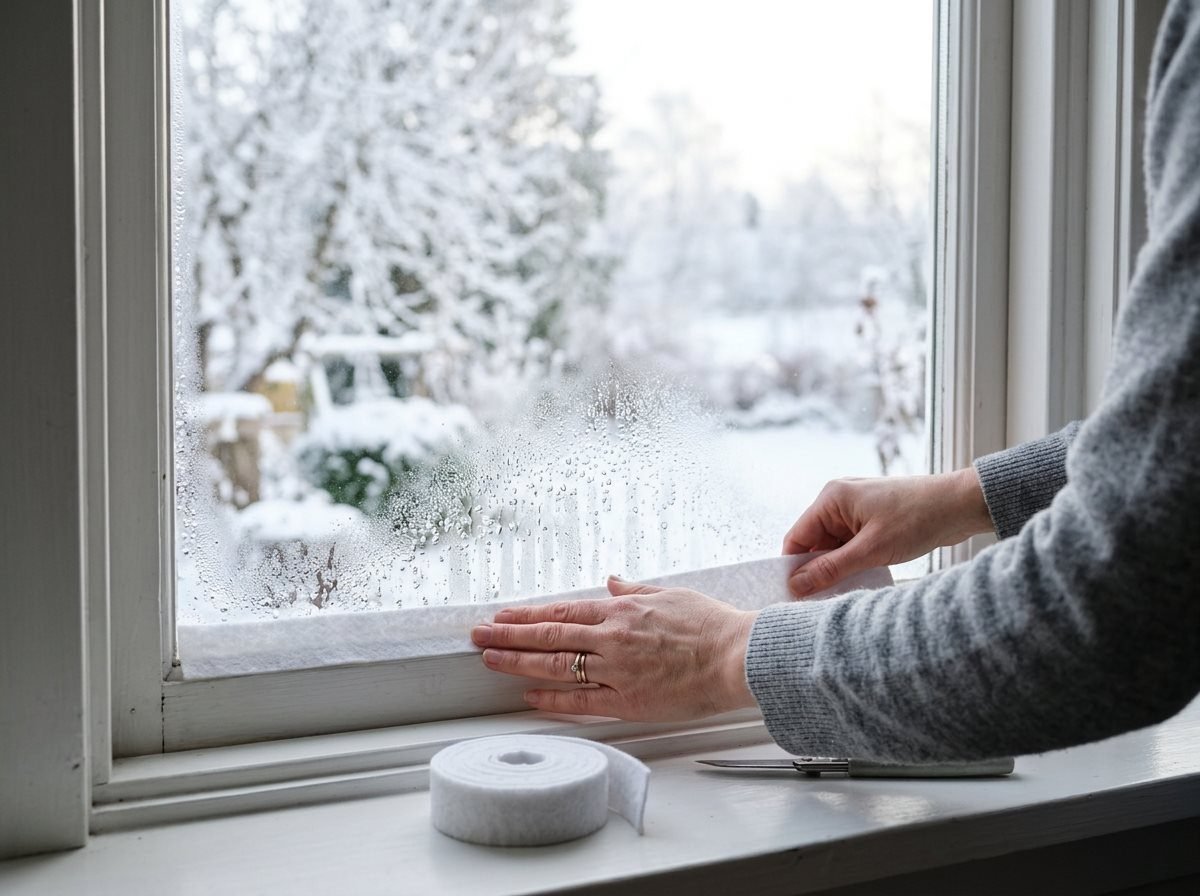
The most critical installation secret: mount the strip so that 80% of its width adheres to the glass pane, while the bottom 20% covers the rubber glazing bead or vinyl junction. Do not stick the strip flat onto the horizontal wood sill! When mounted vertically against the lower glass pane, the felt catches falling droplets the split second they run down the glass, stopping water before it can seep into the micro-gap between the glass and the window frame.
Step 4: Burnish the Adhesive with Firm Pressure
Peel the adhesive backing slowly from left to right, pressing the felt firmly against the glass. Once positioned, take a dry microfiber cloth or a small wallpaper seam roller and press firmly across the entire strip for 30 seconds. Pressure activates the micro-acrylic adhesive polymers, forcing out trapped air bubbles and creating a moisture-tight barrier.
How to Clean, Maintain & Safely Remove Absorber Strips in Spring
To keep your condensation strips hygienic and prevent mold spore accumulation throughout three to four months of cold weather, adhere to these simple maintenance rules:
- Weekly Sanitising Mist: Once a week on a dry sunny afternoon, lightly mist the surface of the felt strip with 3% hydrogen peroxide or a non-acidic botanical thyme spray. This immediately neutralizes any airborne mold spores trapped in the damp fibers without degrading the synthetic felt structure.
- Accelerate Evaporation on Freezing Days: If extreme arctic cold creates continuous sweating that leaves the strip damp at noon, run your room’s ceiling fan on low (clockwise winter mode) or place a small desktop air circulator facing the sill for 20 minutes to evaporate trapped moisture.
- Safe Spring Peeling (Zero Paint Damage): When spring arrives and temperatures stay above 50°F (10°C), do not yank the strip off aggressively. Warm the strip with a household hair dryer on medium heat for 15 seconds to soften the acrylic adhesive. Peel slowly at a 45-degree angle. If any faint adhesive film remains on the glass, wipe it away effortlessly with a cotton pad soaked in rubbing alcohol or mineral oil.
When Condensation Strips Aren’t Enough: 3 Root-Cause Fixes
Absorber strips and sill snakes provide an unbeatable physical defense for your woodwork, but if your home resembles a tropical greenhouse every morning, you must address interior humidity sources:
1. Install Heat-Shrink Window Insulation Kits: If your windows are older double-pane units with failed seals or drafty single panes, adding an interior thermal film creates a sealed dead-air buffer that keeps warm room air completely away from the freezing glass. Read our head-to-head testing of the best window insulation film kits for winter to seal out drafts completely.
2. Target 35% to 40% Indoor Relative Humidity: During deep winter, turn down whole-house humidifiers. When outdoor temperatures hover between 20°F and 32°F (-6°C to 0°C), keep indoor humidity at or below 40%. When temperatures plummet below 10°F (-12°C), lower humidity to 30% to prevent condensation on energy-efficient double glazing.
3. Keep Window Tracks Clear for Drainage: Ensure your exterior window frame weep holes and bottom tracks are free of compacted silt and dirt so that any moisture escaping past sashes drains outdoors freely. Refresh your hardware using our proven method on how to clean window tracks with baking soda and vinegar.
Frequently Asked Questions (FAQ)
Do window condensation absorber strips prevent mold on window sills?
Yes. Mold spores (specifically Cladosporium and Penicillium) require standing water and organic food sources (like wood cellulose, dust, or latex paint binders) to germinate, which typically takes 24 to 48 hours of constant dampness. By absorbing water droplets immediately as they run down the glass pane and accelerating evaporation through high-loft fibers, condensation absorber strips prevent water from pooling against wood sills, halting mold colonization.
How often do you need to replace self-adhesive window condensation tape?
Self-adhesive felt and non-woven condensation strips are designed as single-season consumables. Install fresh strips in late autumn (October or November) and remove them in early spring (March or April). While the synthetic felt fibers do not degrade, repeated cycles of winter moisture absorption and dust accumulation reduce their wicking speed after four to five months. Reusable sill snakes (like the Sataway Microfiber Snake) can be washed and reused for three to five years.
Will adhesive condensation strips damage window paint or leave sticky residue?
High-quality strips made with removable acrylic adhesive (such as StormStop) will not damage sound window paint or leave sticky residues when removed properly. However, to guarantee zero paint peeling, always adhere the strip directly to the glass pane and vinyl glazing bead, rather than sticking it directly onto painted wooden sill boards. When peeling in spring, warm the strip slightly with a hair dryer to release the adhesive cleanly.
Can I wash and reuse felt window moisture absorber strips?
No, adhesive felt tapes cannot be machine-washed because water and detergent destroy the tacky acrylic adhesive backing. If you want a completely washable, reusable option, choose a weighted fabric sill snake (such as the Sataway Microfiber Snake) which has no adhesive and can be machine-washed and tumble-dried dozens of times without losing absorbency.
Why is water pooling behind my condensation strip instead of absorbing?
Water pooling behind a strip occurs when the glass was not properly degreased with isopropyl alcohol prior to application, or when the strip was mounted too high up the pane. If the adhesive does not form an airtight bond with the glass, capillary pressure draws droplets underneath the tape where moisture becomes trapped. To fix this, remove the strip, thoroughly clean the glass with 70% rubbing alcohol, dry completely, and apply a fresh strip with firm roller pressure.
Pingback: How to Stop Window Sweating in Winter (7 Ways to Prevent Sill Puddles) - Cleaning Curb
Pingback: How to Stop Condensation on Double Glazed Windows in Winter