When sub-freezing winter winds howl against old single-pane windows or aging double-glazed sashes, your home’s furnace works overtime fighting a losing thermodynamic battle. Cold glass conducts interior heat rapidly outside, chilling the indoor air touching the pane until it plunges downward—creating freezing interior downdrafts even when your window latches are locked tight. Worse still, warm room humidity collides with that ice-cold glass, dumping pools of condensation onto wood sills and feeding black mold along rubber tracks.
Replacing drafty windows can easily cost $10,000 to $25,000, putting it out of reach for renters and budget-conscious homeowners. Fortunately, a high-grade window insulation film kit delivers immediate thermal relief for under $25 per room. By trapping a stagnant pocket of insulating dead air over the entire window casing, modern window kits eliminate winter drafts, boost window R-value by nearly 100%, and stop interior sweating instantly. In this guide, we compare the best window insulation film kits for winter across classic heat-shrink wrap, reusable magnetic thermal panels, and heavy-duty bubble barriers.
⚡ Direct Answer: What Is the Best Window Insulation Film Kit for Winter?
The 3M Indoor Window Insulator Kit (5-Window Kit) is the best overall window insulation film kit for most homes. Its optically clear 0.75-mil shrink film pulls drum-tight like glass with a hair dryer, while its genuine Scotch mounting tape seals out winter drafts cleanly without peeling paint when removed in spring.
Best Category Winners for Specific Needs:
- Best Heavy-Duty & Pet/Draft Resistant: Duck Brand Max Strength Heavy-Duty Window Kit (thicker tear-resistant film with fast roll-on applicator tape).
- Best for Large Sliding Patio Doors: Frost King V76H Extra-Large Shrink Kit (massive 84″ × 110″ sheet sized for oversized sliders and bay windows).
- Best Reusable & Openable Option: DIY Magnetic Thermal Window Insulation Kit (thick clear PVC sheet on perimeter magnetic strips so you can peel open for fresh air).
- Best Maximum R-Value (Basements/Garages): Reflectix Double-Bubble Radiant Barrier Roll (adds maximum R-value and stops radiant heat loss where visibility isn’t required).
Struggling with morning puddles on your window sills before sealing up for winter? First read our guide on how to stop window sweating in winter and clean off any track spores using our safe rubber seal mold removal protocol before sealing the frame.
The Physics: How a Thin Sheet of Plastic Stops Winter Heat Loss
It seems counterintuitive that a sheet of plastic thinner than a grocery bag can meaningfully insulate a home. The secret is not the plastic film itself—it is the stagnant pocket of dead air trapped between the film and the cold glass.
- Doubling Effective R-Value: Standard single-pane glass has a thermal resistance value of roughly R-0.9 (solid glass conducts heat swiftly). When you seal an airtight plastic sheet across the inner trim casing, you capture a 1-to-3 inch cushion of trapped air. Air is an extraordinarily poor conductor of heat, pushing your window’s total R-value up to R-1.7 to R-1.9—essentially matching an older double-pane window!
- Killing Convective Downdrafts: Warm room air hits cold window glass, cools down, becomes dense, and plunges straight down onto the floor, creating an uncomfortable cold breeze even if zero outside air is leaking in. The insulation film breaks that convective loop completely.
- Breaking the Condensation Dew Point: Window sweating happens when warm, moist indoor air touches ice-cold glass below the dew point temperature. Because your room air now touches only the room-temperature plastic film (not the freezing glass), interior window condensation stops almost instantly.
Shrink Wrap vs. Magnetic Thermal Panels vs. Bubble Foil
Before ordering a kit, decide which of the three architectural designs suits your windows and lifestyle:
- 1. Heat-Shrink Polyolefin Film (Single Season): Uses double-sided acrylic tape applied to the window trim. Once attached, heat from a hair dryer aligns the polymer chains, shrinking all wrinkles out until the plastic becomes virtually invisible. Best for maximum optical clarity and lowest cost. Cannot be opened until spring.
- 2. Magnetic Strip PVC Panels (Multi-Season Reusable): Thick clear vinyl sheets fitted with flexible magnetic perimeter tracks that latch onto adhesive magnetic strips on your frame. You can snap open a corner on warm days to ventilate, and reuse the sheet for 3 to 5 winters.
- 3. Radiant Foil / Thermal Bubble Insulation (Utility Areas): Polyethylene air bubbles laminated with reflective aluminum foil (or clear double-bubble wrap misted directly onto glass). Blocks light and views completely, making it ideal for garages, attics, RV windows, and dark basement panes.
Top 5 Window Insulation Film Kits for Winter (Tested & Reviewed)
We evaluated leading thermal window insulation kits for clarity, tape adhesion strength, paint-safe removal, and draft blocking:
1. 3M Indoor Window Insulator Kit (5-Window Pack)
Crystal-clear 0.75-mil heat-shrink film (62″ × 210″ roll) paired with genuine Scotch double-sided indoor mounting tape.
- Industry-best clarity: once shrunk, it is practically indistinguishable from real glass.
- Scotch mounting tape holds fiercely through brutal wind chills without detaching mid-winter.
- Cleanest spring release on properly cured wood, vinyl, and aluminum casings.
- Covers five standard 3-ft × 5-ft windows cleanly in one kit.
- Requires careful cutting of one massive continuous roll with household scissors.
- 0.75-mil polyolefin film can puncture if curious cats claw at the window sill.
The 3M Indoor Window Insulator Kit sets the gold standard for clarity and reliability. Budget generic kits routinely suffer from two fatal flaws: cloudy haze in the film and weak glue on the double-sided tape that releases in January once the film pulls tight. 3M solves both. Its proprietary polyolefin sheet shrinks cleanly with uniform tension under low heat, and its genuine Scotch adhesive stays airtight until you choose to take it down in April.
2. Duck Brand Max Strength Heavy-Duty Window Kit
Double-thick, puncture-resistant heavy-duty shrink wrap film built for homes with pets, toddlers, and severe wind gusts.
- 100% thicker gauge than standard shrink film; resists accidental bumps, curtains, and pet paws.
- Withstands high wind pressure rattling against leaky, older single-pane sashes.
- Excellent value per square foot for multi-window installations.
- Shrinks wrinkle-free using a standard household hair dryer on high setting.
- Thicker film takes 20–30% longer to shrink tight with a hair dryer compared to 3M standard film.
- Very slightly thicker plastic sheen compared to ultra-thin 0.75-mil variants.
If standard thin window film always gets poked through by blinds, curtains, or pets rubbing against the glass, step up to the Duck Brand Max Strength Window Kit. Engineered to be twice as thick as standard indoor wrap, it provides a resilient membrane that doesn’t slacken or billow violently when heavy winter gusts blow through loose storm sashes. Just hold your hair dryer steady for an extra second or two per section to fully pull the thicker polymer taut.
3. Frost King V76H Extra-Large Patio Door Shrink Kit
Massive 84-inch × 110-inch continuous sheet designed to seal expansive sliding glass patio doors and picture windows.
- Covers massive 7-ft × 9-ft glass spans in one uninterrupted sheet with zero seams.
- Includes extra-long perimeter double-sided adhesive roll.
- Eliminates freezing cold air waterfalls radiating off unused winter sliding glass patio doors.
- Dramatically lowers living room floor chills near backyard sliders.
- Two people are strongly recommended during installation to keep the 84″×110″ sheet aligned.
- Blocks physical usage of the sliding patio door for the winter season.
Standard residential window kits cap out at 62 inches wide—useless for an 80-inch sliding glass door or wide picture window. If you don’t use your backyard slider during deep winter, the Frost King V76H Patio Door Kit is the single highest-ROI energy improvement you can make. Sliding doors are notorious for worn weatherstripping and freezing aluminum floor tracks; covering the whole unit in a seamless 84″ × 110″ thermal blanket turns a frosty wall of glass into a warm, draft-free barrier.
4. DIY Reusable Magnetic Thermal Window Insulation Kit
Heavy-gauge clear PVC thermal barrier secured via snap-fit grooved perimeter magnetic strips—peel open anytime.
- 100% Reusable for 3 to 5 winters—roll up and store neatly in the spring rather than throwing plastic away.
- Zero hair dryer required during setup; fastens magnetically along the frame.
- Lets you peel back a corner to unlock and open your window on mild afternoons.
- Far thicker and stronger than polyolefin shrink film.
- PVC sheet shows mild visual ripples/distortion compared to drum-tight heat-shrink film.
- Costs more upfront per window ($30–$55) and requires precise trimming to frame size.
Hate throwing away single-use plastic every spring—or live in a bedroom where you still want to crack the window open during winter warm spells? A DIY Magnetic Thermal Window Kit replaces temporary double-sided tape with a two-part magnetic frame track. You stick the slim magnetic base trim to your casing once, clip the thick transparent PVC panel inside the grooved PVC top strip, and press it shut. Anytime you need ventilation or emergency egress, simply peel a bottom corner back and snap it sealed again.
5. Reflectix Double-Bubble Radiant Barrier Window Roll
Double layer of encapsulated air bubbles sandwiched between 97%-reflective foil sheets for unmatched thermal resistance.
- Delivers the highest thermal R-value boost (R-2.0+ effective barrier).
- Zero adhesive tape needed: friction-fit precisely inside recessed window jambs or mist glass lightly with water for clear bubble wrap.
- Reflects indoor furnace heat back into the room in winter and rejects summer solar heat in July.
- 100% opaque—blocks all natural sunlight and outside views completely.
- Can overheat double-pane glass seals if exposed to extreme direct summer afternoon sun (use primarily on north-facing or winter garage/basement windows).
Technical Comparison Matrix: Best Window Insulation Kits
Compare film thickness, optical visibility, installation mechanics, and cost efficiency side-by-side:
| Kit Name | Film Type | Optical Clarity | Attachment System | Reusable? | Best Application |
|---|---|---|---|---|---|
| 3M Indoor Insulator Kit | 0.75-mil Heat Shrink | Crystal Clear (Glass-Like) | Scotch Double-Sided Tape | Single Season | Living rooms, bedrooms, rentals |
| Duck Brand Max Strength | 1.5-mil Thick Shrink | Very Clear (Slight sheen) | Heavy-Duty Mounting Tape | Single Season | Pet owners, leaky old frames |
| Frost King V76H Kit | 0.75-mil XL Heat Shrink | Crystal Clear | Double-Faced Acrylic Tape | Single Season | Sliding patio doors & bay windows |
| Magnetic Thermal Kit | 0.2mm Clear PVC Vinyl | Good (Visible PVC edge) | Adhesive Magnetic Track | Yes (3–5 Years) | Windows you need to open occasionally |
| Reflectix Bubble Roll | Double Bubble + Foil | 0% (100% Opaque) | Friction-Fit (Zero Tape) | Yes (Indefinite) | Basements, garages, RV windows |
Pro Installation Protocol: How to Avoid Peeling Tape & Melting Holes
Ninety percent of window insulation failures happen during installation—either tape peels off two weeks later, or an aggressive hair dryer melts a hole in the plastic. Follow these five steps for an airtight, glass-clear finish:
- Clean the Window Glass & Degrease the Trim: First, wash your interior glass clean (check our sub-zero window cleaning guide if the glass is freezing outside) because once sealed, you won’t reach that glass until April. Next, wipe the painted trim or vinyl molding with 70% isopropyl rubbing alcohol. Never skip this step! Household dust, furniture polish, and skin oils prevent acrylic tape from bonding.
- Apply Double-Sided Tape Under Firm Pressure: Press the tape firmly along the top, sides, and bottom window casing in continuous strips without gaps. Leave the protective paper backing on while placing all four sides, then go back and run a dry thumb firmly down every inch to activate pressure-sensitive adhesion.
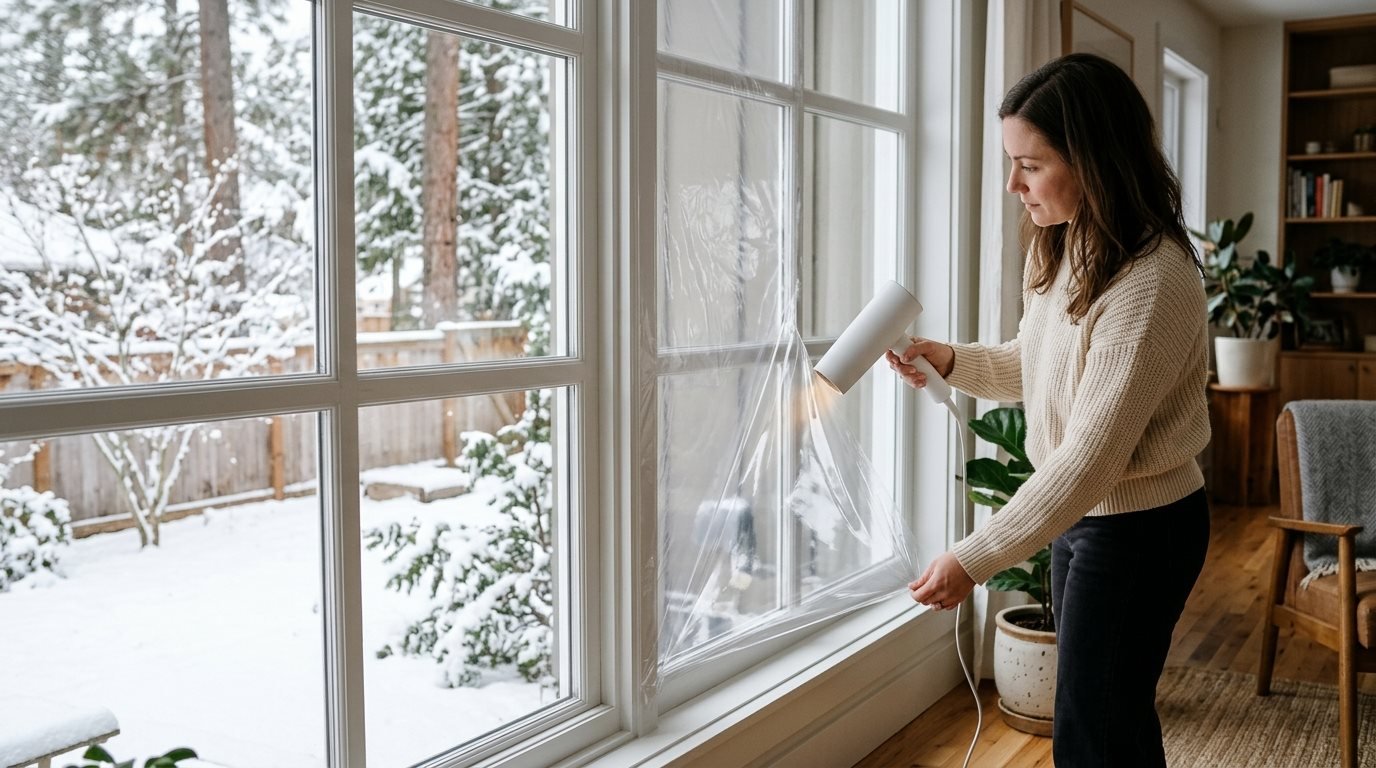
- Hang Top-to-Bottom with 2 Inches of Slack: Peel off the top strip’s paper liner first, press the plastic film evenly across the top bar (leaving 2 inches of extra overhang), then peel the left, right, and bottom liners while smoothing the sheet gently by hand. Do not pull it drum-tight yet; slight loose waves are completely normal.
- Shrink Center-Outward (Not Edge-First): Set a standard hair dryer to High heat. Hold the nozzle 4 to 6 inches away from the film and move continuously in sweeping horizontal passes—starting in the center of the window and working gradually toward the tape borders. Watch as creases magically melt away into glass-like tension! Warning: Never linger on one spot, or the polyolefin will split cleanly open.
- Trim Excess Border Flush: Once cooled and tight, trace a fresh razor blade or sharp scissors carefully along the outside edge of the tape line to slice away leftover dangling plastic skirts.
Safe Spring Removal: Removing Tape Without Peeling Paint
When April arrives and you’re ready to open the windows, never rip the tape off dry in one fast yank—fast mechanical shear can rip poorly primed latex paint straight off vintage wood moldings.
Instead, take your hair dryer and warm the remaining adhesive tape strip for 10 seconds to soften the acrylic glue. Then, grip an edge and pull slowly backward at a flat 180-degree parallel angle (pulling straight along the frame rather than straight out toward the room). Any tiny adhesive flecks left behind wipe effortlessly off with a cloth lightly dampened in rubbing alcohol or Goo Gone.
Also noticing hazy moisture trapped INSIDE double-pane window units? Insulation kits stop interior surface sweating, not broken seals between panes—diagnose your glass in our guide on why windows get foggy between the panes and how to control condensation on double-glazed windows in winter.
Not ready to install full shrink-wrap film across your window frames? Check our tested roundup of the best window condensation absorber strips to catch morning glass runoff with zero optical obstruction.
Frequently Asked Questions (FAQ)
Do window insulation film kits really save money on heating bills?
Yes. According to residential energy audits and the U.S. Department of Energy, windows account for roughly 25% to 30% of residential heating energy loss. Properly sealing leaky single-pane or aging aluminum windows with clear thermal shrink kits can reduce draft-related heat loss through those openings by 35% to 50%, typically recouping the $20 kit cost within the very first winter heating cycle.
Can you open a window after installing shrink film?
No. Standard heat-shrink film (like 3M and Duck Brand) is sealed permanently over the interior window frame casing until you cut or peel it off in spring. Never install heat-shrink film over the only emergency fire-egress window in a basement bedroom without keeping scissors nearby, or opt for a Magnetic Thermal Window Kit that unlatches in one second.
Does window insulation film stop window condensation completely?
Yes, it stops interior room condensation almost completely! Because the tape forms an airtight seal around the trim, warm humid indoor air can no longer reach the freezing cold glass surface. Wait until midday when your window is bone-dry before hanging the film so you don’t seal pre-existing moisture inside the airspace.
Should I apply window insulation film on the inside frame or directly on the trim?
If your window has a deep wooden or vinyl recess (at least 1 inch from the sash locks/cranks to the room edge), you can mount the tape inside the jamb casing so your blinds or interior shades still slide cleanly in front of the film. If your sash hardware sticks out too far, mount the tape along the flat exterior face of the decorative wooden trim molding instead.