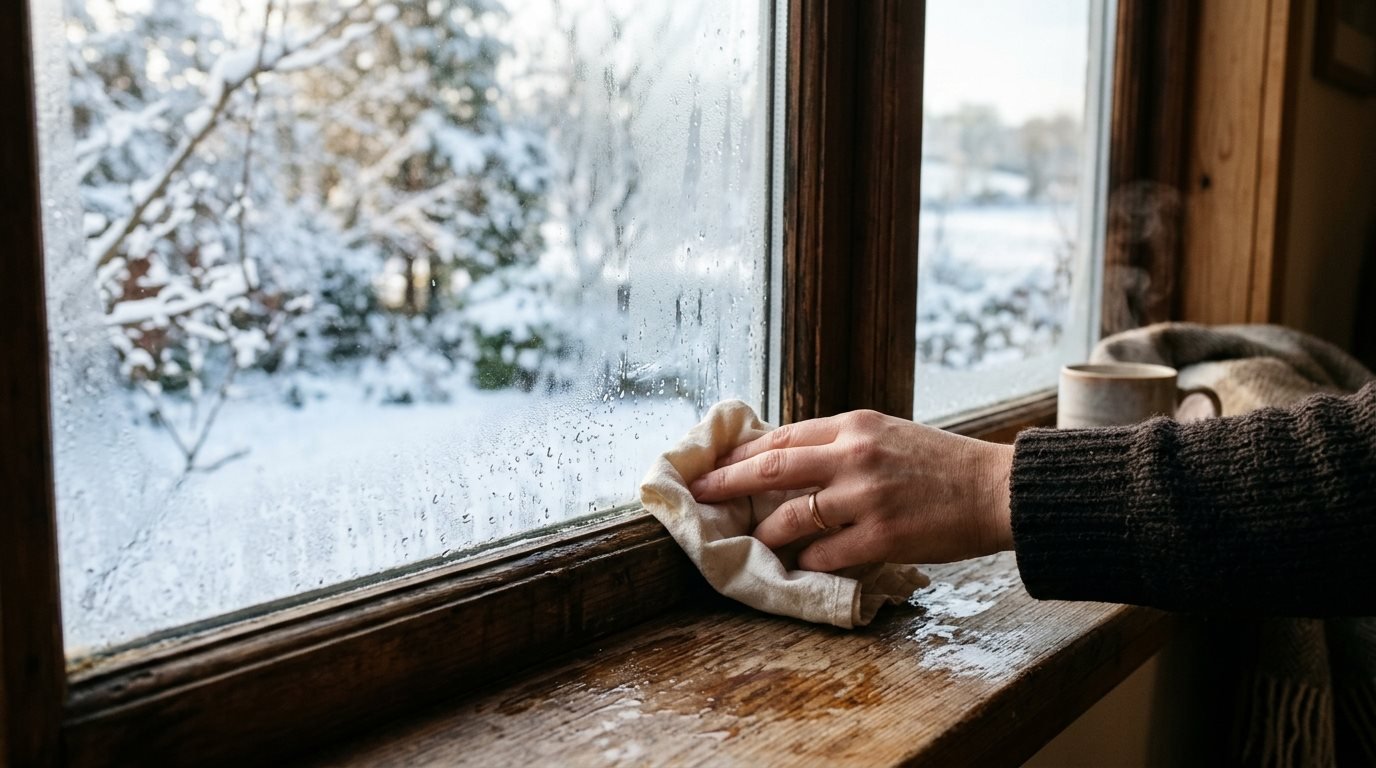
Few sights fill a homeowner with greater dread on a freezing winter morning than walking into a bedroom or living room to find windows “sweating” profusely. Heavy condensation beads stream down the glass like miniature waterfalls, pooling into stagnant puddles along painted wooden sills, saturating drywall corners, bubbling paint, and creating an ideal breeding ground for toxic black mold.
While many assume window sweating means their windows are defective or need immediate multi-thousand-dollar replacement, the truth is almost always rooted in physics: indoor relative humidity colliding with cold glass. In this comprehensive guide, we break down the 7 proven protocols to stop window sweating in winter, protect your trim from water rot, and eliminate morning sill puddles for good.
💡 Direct Answer: How to Stop Window Sweating in Winter
To stop windows from sweating in winter and prevent water puddling on interior sills:
- Circulate warm ceiling air: Set ceiling fans to rotate clockwise on low speed to push warm trapped air down across cold window panes, keeping glass above the dew point.
- Crack curtains and blinds open by 1–2 inches: Tightly closed drapes trap a cold, stagnant pocket of humid air against the pane, accelerating severe overnight sweating.
- Regulate indoor humidity to 30%–40%: Run bathroom exhaust fans for 20 minutes post-shower, keep lids on cooking pots, and operate a compressor dehumidifier in primary bedrooms.
- Install clear heat-shrink insulation film: Adding clear thermal shrink film creates an insulating dead-air pocket that raises glass surface temperatures by 10°F to 15°F, stopping sweating instantly on single and older double-pane glass.
- Place washable microfiber sill absorbers: Lay absorbent condensation snakes or microfiber channel strips along sills to catch runoff before water penetrates wood or drywall.
Is the fog trapped inside the glass where you can’t touch it? If wiping the surface with a towel doesn’t remove the moisture, your window seal is broken. Read our diagnostic guide on why windows become foggy between the panes and how to fix blown IGU seals.
The Physics of Window Sweating: Understanding the Dew Point
❄️ Need an Instant Thermal Barrier Against Sweating Glass?
If you have older single-pane windows, creating an airtight dead-air pocket breaks the dew-point loop completely. Read our hands-on comparison of the best window insulation film kits for winter (including shrink wrap vs. magnetic options).
🦠 Winter Sweating Colonizing Your Rubber Gaskets?
When morning condensation pools in the lower sash track, black mold attacks rubber weatherstripping. Learn how to kill the spores and recondition dry gaskets in our guide on cleaning mold from window track rubber seals safely.
Window sweating is not a failure of the glass; it is a basic thermodynamic event. Air contains water vapor, and warm air can hold significantly more moisture than cold air. When warm, humid indoor air ($70^circ ext{F}$ at 50% relative humidity) comes into contact with a cold window surface ($45^circ ext{F}$ or lower due to freezing outdoor temperatures), the air immediately adjacent to the glass cools down rapidly.
As that air cools, it reaches its dew point—the exact temperature at which air becomes 100% saturated and can no longer hold water vapor. The excess vapor instantly condenses into liquid water beads on the cold glass pane. Once thousands of micro-droplets merge, gravity takes over: water streams downward, fills the lower sash groove, and overflows onto your wooden sill.
Every single day, normal household activities inject gallons of liquid water directly into your indoor air:
- Breathing & Perspiration: A family of four exhales roughly 1.5 to 2 gallons of water vapor every 24 hours.
- Cooking & Dishwashing: Boiling water, brewing coffee, and washing dishes adds another 1 gallon daily.
- Hot Showers: A 10-minute hot shower adds nearly 0.5 gallons of high-temperature vapor per person.
- Indoor Clothes Drying & Houseplants: Wet laundry drying on racks and collections of potted plants contribute up to 1 gallon of continuous moisture.
Outdoor Temperature vs. Safe Indoor Humidity Target Chart
To eliminate window sweating, your indoor relative humidity (RH) must adjust downward as the outdoor temperature drops. Use an inexpensive digital hygrometer to monitor your rooms and match this engineering guideline:
| Outdoor Temperature (°F) | Outdoor Temperature (°C) | Maximum Safe Indoor Relative Humidity | Risk Level if Exceeded |
|---|---|---|---|
| 40°F and Above | 4°C and Above | 45% to 50% | Low (Sweating rare on double-pane glass) |
| 20°F to 40°F | -6°C to 4°C | 40% | Moderate (Light mist along bottom pane) |
| 10°F to 20°F | -12°C to -6°C | 35% | High (Sweating begins pooling on sills) |
| 0°F to 10°F | -18°C to -12°C | 30% | Severe (Waterfalls and sill flooding) |
| Below 0°F (Sub-Zero) | Below -18°C | 20% to 25% | Extreme (Frost and ice formation on glass) |
7 Proven Protocols to Stop Window Sweating in Winter
Want to stop glass from fogging up before condensation beads into sill puddles? Explore our hands-on review of the best anti-fog sprays for windows in winter tested for zero rainbow glare and long-lasting steam resistance.
Implement these practical, physics-backed solutions to eliminate window sweating and keep your window sills dry all winter long:
Protocol 1: The Ceiling Fan “Winter Mode” Trick (Clockwise on Low)
Most homeowners turn ceiling fans off in October, not realizing that ceiling fans are one of the most effective anti-sweating tools in the home. In winter, warm air naturally rises and pools against the ceiling ($75^circ ext{F}$), while cold, heavy air settles near floors and window glass ($60^circ ext{F}$).
Flip the directional switch on your ceiling fan motor so the blades spin clockwise, and run it on the lowest speed. Running clockwise creates a gentle updraft at the center of the room that pushes trapped warm ceiling air outward toward the walls. That warm air then cascades down across your window panes, raising the glass surface temperature by $5^circ ext{F} ext{ to }8^circ ext{F}$—well above the dew point—without creating an uncomfortable chilling breeze.
Protocol 2: The 2-Inch Curtain Air Gap (Busting the Cold Microclimate)
It feels intuitive to close heavy blackout drapes or cellular shades tightly on freezing winter nights to keep cold drafts out. However, tightly closed window coverings are often the primary cause of severe overnight window sweating.
When curtains are closed flush against the wall, they act as an insulating barrier that cuts the window glass completely off from household heating. Warm room air cannot reach the pane, so the small pocket of air trapped behind the curtain plummets in temperature. Because the air cannot circulate, the humidity condenses relentlessly against the freezing pane all night long.
The Fix: Leave curtains, blinds, and Roman shades raised or opened by 1 to 2 inches at the bottom overnight. This allows natural convective warm room air to enter the window alcove, circulate across the lower glass, and keep condensation from forming.
Protocol 3: Active Moisture Management & Ventilation
You cannot stop cold winter weather outside, but you have 100% control over indoor moisture generation:
- The 20-Minute Exhaust Fan Rule: Turn on your bathroom exhaust fan before stepping into the shower and let it run for a full 20 minutes after you finish. This expels several pounds of vapor before it can migrate down hallways into bedrooms.
- Keep Cookware Covered: Always cook with lids on pots and run the stove exhaust fan on high whenever boiling water or simmering soups.
- Bedroom Dehumidification: If bedroom windows sweat heavily overnight, run a compact compressor dehumidifier set to 40% RH. Two sleeping adults exhale roughly 1 liter of moisture per night into a closed bedroom.
Protocol 4: Install Clear Thermal Shrink Film Kits
If you live in an older home with single-pane windows or older double-pane windows with metal spacers, insulating shrink film kits (such as 3M Window Insulator Kits) provide an immediate, 100% cure for window sweating.
Applied to the interior frame with double-sided tape and shrunk crystal-clear with a household hair dryer, thermal film creates an airtight 1/2-inch dead-air chamber. The interior film sheet stays warm at room temperature ($65^circ ext{F}+$), meaning moisture in the room never touches a surface cold enough to trigger condensation. Thermal film also cuts window heat loss by up to 35%, slashing winter heating bills.
Protocol 5: Deploy Washable Microfiber Sill Absorbers
For rental apartments where installing shrink film is prohibited or for historic wood sashes that sweat during extreme cold snaps, physical absorption channels protect your trim from permanent damage:
- Condensation Snakes / Draught Ribbons: Long, narrow tubes filled with moisture-absorbing silica gel beads or dense microfiber batting placed directly against the bottom glass rail.
- Microfiber Channel Strips: Cut narrow strips of high-GSM plush microfiber cloth and tuck them along the lower sash track. They wick away morning runoff capillary-style, allowing moisture to evaporate safely back into the room without pooling on wood.
Protocol 6: Clear Frame Weep Holes & Open Trickle Vents
Many modern vinyl and aluminum windows feature built-in drainage systems called weep holes on the exterior sill. When interior condensation drips down into the lower vinyl track, it is designed to drain outside through these baffled channels.
If your weep holes are clogged with dirt, dead bugs, or dried leaves, water cannot drain. The puddle rises, submerges lower rubber gaskets, and overflows into your interior living space. Inspect exterior weep flaps twice a year and clear obstructions using a zip tie or compressed air.
Protocol 7: Move Dense Houseplants Away from Cold Sills
Plants are natural humidifiers. Up to 97% of the water you pour into a potted plant transpires out through its leaves as invisible water vapor. When homeowners line cold winter window sills with ferns, peace lilies, and tropical plants, they create a hyper-localized microclimate with relative humidity exceeding 70% right against sub-freezing glass.
Move dense houseplants 3 to 5 feet into the interior of the room during winter months to disperse transpiration moisture into the broader living space where home heating can absorb it.
Damage Control: Protecting Wooden Window Sills from Water Rot & Mold
If window sweating has already created puddles on your sills, take immediate protective action to avoid costly structural repairs:
- Apply a Protective Carnauba Paste Wax Barrier: Buff a generous coat of automotive carnauba paste wax over painted or varnished wooden window sills. The micro-crystalline wax creates a hydrophobic barrier that forces water puddles to bead up tightly rather than soaking into wood grain or peeling paint.
- Never Use Bleach on Moldy Sills: If dark fungal colonies have already sprouted along your sill caulk, do not spray chlorine bleach. Bleach is 90% water; while it bleaches the surface spores, the water soaks into porous wood, feeding deep mycelium roots. Instead, follow our non-toxic protocol on how to clean black mold from window sills without bleach using 3% hydrogen peroxide or tea tree oil.
- Wipe Morning Moisture with a Dedicated Squeegee: Keep a compact handheld window vacuum or squeegee nearby to vacuum up morning beads in under 10 seconds before heading to work.
Frequently Asked Questions (FAQ)
Can window sweating cause structural rot in walls and floors?
Yes. When window sweating goes unaddressed for multiple winter seasons, moisture seeps behind trim mouldings, saturating drywall, drywall anchors, and internal rough 2×4 framing studs. Over time, chronic water intrusion leads to dry rot, structural wood decay, peeling exterior siding paint, and severe hidden black mold colonies inside wall cavities.
Does wiping shaving cream or dish soap on windows stop sweating?
Wiping dish soap or shaving cream leaves a microscopic surfactant film that breaks the surface tension of water, temporarily preventing beads from forming. However, it does not stop the moisture from condensing. Instead of forming droplets, the water forms a flat, slimy sheet that still runs down the glass and pools on the sill. It is a messy short-term gimmick that requires frequent reapplication and attracts dust.
Why do my windows sweat mostly in the master bedroom?
Two sleeping adults exhale approximately 1 liter (roughly 1 quart) of water vapor during eight hours of sleep. When the bedroom door is closed overnight, that concentrated moisture cannot disperse into the rest of the house. As room temperatures drop slightly in the early morning hours, the dew point is reached and heavy sweating covers the bedroom glass.
Do new replacement windows stop window sweating?
New energy-efficient windows with Low-E glass, argon gas fill, and non-metallic “warm-edge” spacers stay significantly warmer on the interior glass pane ($55°F to $60°F compared to $35°F on old single panes). This dramatically reduces window sweating. However, if indoor humidity remains excessively high (above 55%), even the most advanced triple-pane windows will eventually sweat.