It is one of the most maddening discoveries a homeowner can make: you walk up to a window expecting to wipe away a light haze of morning mist, but your microfiber towel glides effortlessly across bone-dry glass. Puzzled, you step outside onto the patio, reach up to wipe the exterior pane, and discover that side is perfectly dry as well. The condensation, foggy streaks, and water droplets are trapped entirely inside the sealed glass sandwich—completely out of reach.
Unlike ordinary window condensation that wipes away with a squeegee, moisture between the panes of a modern double-pane or triple-pane window is not an everyday cleaning issue. It is the definitive symptom of a failed hermetic window seal on your Insulated Glass Unit (IGU). Understanding why this happens, how to differentiate it from surface humidity, and what your realistic repair options are can save you hundreds—or even thousands—of dollars in unnecessary window replacements.
💡 Direct Answer: Why Are Windows Foggy Between the Panes?
Windows become foggy between the panes when the perimeter hermetic seal of the Insulated Glass Unit (IGU) fails. As the elastic seal deteriorates from years of thermal expansion and contraction (“solar pumping”), the insulating argon or krypton gas escapes and humid outside air is drawn into the cavity. Once the moisture-absorbing desiccant pellets inside the spacer bar become 100% saturated, ambient temperature drops cause moisture to condense on the inaccessible inner glass surfaces.
Can you clean or wipe it off? No. The moisture is hermetically trapped. DIY defogging kits (micro-drilling) offer only temporary cosmetic relief and permanently ruin insulation value.
The Permanent Solution: You do not need to replace the entire window frame ($600–$1,800+). A local glass technician can replace just the glass IGU insert ($150–$350 per sash) while keeping your existing frame, trim, and wall structure completely intact.
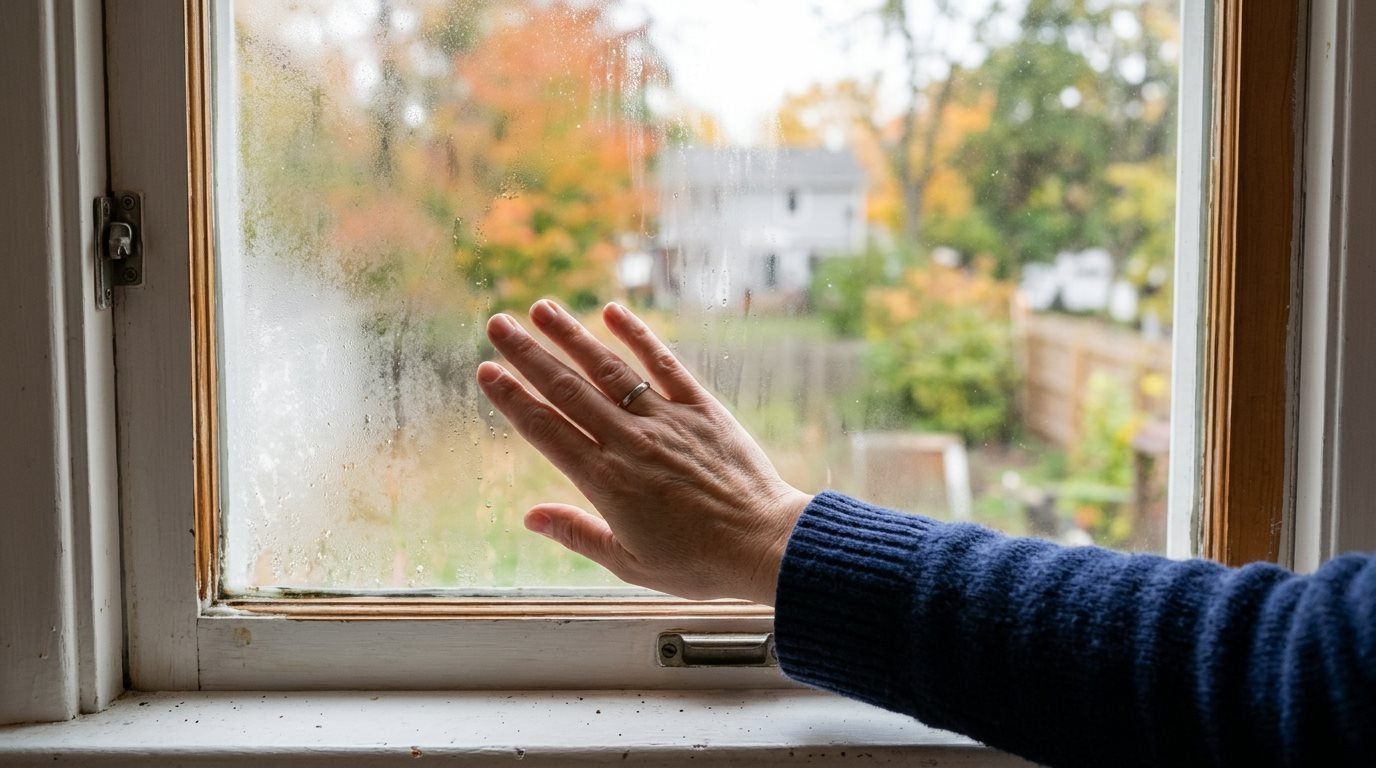
Is your condensation forming on the room-facing surface of your glass instead? If the moisture wipes off easily with a cloth, read our dedicated guide on how to stop surface condensation on double glazed windows in winter.
Diagnostic Checklist: 3 Tests to Pinpoint the Exact Location of the Fog
💧 Dealing with Room-Side Window Sweating Instead?
If your condensation wipes off with a towel and pools on your sill, your seal is intact but your room air is too humid. See our 7 proven fixes on how to stop window sweating in winter.
Before calling a glass contractor, perform these three quick diagnostic checks to confirm whether you are dealing with harmless room humidity or an unrecoverable seal failure:
1. The Two-Sided Towel Wipe Test
Take a dry microfiber towel and firmly wipe the fogged area from the inside of your home. If the glass remains cloudy, walk outside (or open the window if on an upper story) and wipe the exterior surface. If both towels come away bone-dry and the foggy mist does not shift or smear at all, the moisture is 100% interstitial (sealed inside the IGU cavity).
2. The Fingernail & Razor Drag Test
Drag the edge of your fingernail or a plastic scraper across the foggy section on both sides of the window. If you feel mineral grit, textured water scale, or grease, but your cloth cannot remove it, you are looking at permanent silica etching on the interior facing surfaces of the sealed unit. When moisture sits between panes for months, evaporated water leaves behind white calcium and sodium mineral blooms that permanently chemically etch the glass.
3. The Ice Cube Thermal Test
If you suspect the moisture might just be temporary room condensation caused by high indoor humidity, place a plastic bag filled with ice cubes against the interior room-facing glass for 5 minutes. Remove the ice and examine the glass:
- Condensation forms on the room side: Your indoor relative humidity is too high (above 50%), cooling against cold outdoor glass. Your window seals are likely intact.
- Condensation remains trapped inside the gap: The seal is breached. The sudden localized chill triggered dew-point condensation within the moist air already trapped between the two panes.
Comparison Table: Failed Seal vs. Interior vs. Exterior Condensation
Not all window moisture is bad news. Compare your symptoms against this diagnostic matrix:
| Feature / Factor | Failed Window Seal | Interior Condensation | Exterior Morning Dew |
|---|---|---|---|
| Moisture Location | Between the two glass panes | Inside the room (on interior glass) | Outside the home (on outdoor glass) |
| Can You Wipe It Off? | No (Inaccessible) | Yes (Easily wipes away) | Yes (Easily wipes away) |
| Primary Cause | Compromised perimeter adhesive + saturated desiccant | Excess indoor humidity + cold outside air | High outdoor humidity + efficient low-E glass |
| Window Health Meaning | Terminal: Insulating gas lost; seal broken | Window is fine; indoor ventilation needed | Excellent: Proof of superior thermal insulation |
| Impact on Energy Bills | R-value drops by 30% to 50% | None directly | None (Zero energy loss) |
| Required Fix | Replace glass IGU insert ($150–$350) | Run dehumidifier, exhaust fans, vent air | Do nothing; burns off with morning sun |
The Anatomy of an IGU & Why Window Seals Fail
To understand why double-pane windows fail, you must understand how an Insulated Glass Unit (IGU) is manufactured. Modern double-pane windows are not just two loose sheets of glass dropped into a frame. They are precision-engineered hermetic chambers:
- Dual Panes of Glass: Typically 3mm to 4mm thick, separated by an air gap ranging from 1/2 inch to 3/4 inch.
- The Spacer Bar: A hollow perimeter channel made of aluminum, stainless steel, or composite foam (“warm-edge” spacers) that maintains exact separation between panes.
- Desiccant Beads: The hollow interior of the spacer bar is packed with thousands of tiny crystalline silica gel beads or molecular sieves. Their job is to absorb the minute traces of moisture sealed in the air gap during factory assembly.
- Primary Seal: A bead of polyisobutylene (PIB) extruded along the edges. PIB is one of the lowest gas-permeable materials on earth; its sole purpose is to keep argon gas in and water vapor out.
- Secondary Seal: A heavy outer band of structural silicone, polysulfide, or polyurethane that mechanically glues the glass sandwich together.
- Gas Fill: Dense inert gas (typically Argon or Krypton) pumped into the chamber to provide 30% to 50% higher thermal resistance than plain air.
The Destructive Force of “Solar Pumping”
Every single day, your windows undergo an invisible mechanical torture cycle known as solar pumping. When morning sunlight hits the glass, the trapped gas inside the IGU heats up and expands, pushing outward against the flexible perimeter seals. When the sun sets and temperatures plummet, the gas contracts, creating a partial vacuum that pulls inward on the seals.
Over 10 to 15 years, this daily expansion and contraction flexes the elastic adhesive millions of times. Eventually, microscopic hairline fractures develop in the polyisobutylene seal. Dense argon gas escapes outward, and atmospheric air carrying water vapor is drawn inward.
The Saturated Desiccant Threshold
When a microscopic breach first occurs, you will not see fog immediately. Why? Because the desiccant beads inside the spacer bar silently absorb the invading water vapor. A typical window spacer holds enough desiccant to absorb roughly 15% to 20% of its dry weight in water.
However, once the desiccant reaches 100% saturation capacity, it can hold no more. On the very next chilly day or cold autumn night, the dew point is reached inside the gap, and visible moisture blooms across the glass. Once this occurs, the seal failure is irreversible.
The Threat of Clogged Weep Holes
While solar pumping is normal wear, premature seal failure (in windows under 7 years old) is almost always caused by standing water in the bottom window frame. If your exterior window weep holes are clogged with dirt and dead bugs, rainwater backs up into the sash channel, submerging the bottom edge of the IGU for weeks. Prolonged water immersion dissolves secondary silicone adhesives and degrades polyisobutylene seals rapidly.
Debunking DIY Defogging Kits & Miracle Internet Fixes
A quick search on YouTube or Reddit reveals numerous “miracle hacks” promising to fix foggy windows between panes for $20. Before drilling holes in your expensive windows, here is what science and professional glaziers say about these methods:
Myth 1: DIY Micro-Drilling & Valve Defogging Kits
Commercial defogging services and DIY drill kits involve drilling two tiny 1/8-inch holes in the corners of the outer glass pane, spraying a rinsing solution and surfactant into the cavity to rinse away mineral haze, sucking out moisture with a vacuum, and inserting micro-vented plastic plugs.
The Reality: This is purely cosmetic and short-lived. Drilling holes permanently destroys any remaining insulating argon gas. The desiccant beads inside the spacer remain waterlogged and cannot be dried out. Within 12 to 18 months, outdoor dust, exhaust soot, and microscopic insects penetrate the vent plugs, leaving dirty streaks inside the glass that can never be washed. Most glass warranties are also instantly voided.
Myth 2: Blowing a Hair Dryer on the Glass
Some homeowners try blowing hot air from a hair dryer onto the glass to evaporate the trapped moisture. While heat temporarily turns liquid droplets back into invisible vapor, that vapor has nowhere to escape. As soon as the glass cools down at nightfall, the moisture condenses right back onto the panes. Furthermore, unevenly heating thick double-pane glass risks thermal shock fracture, cracking the pane entirely.
Myth 3: Caulking the Exterior Glass-to-Frame Joint
Smearing silicone caulk around the perimeter of the exterior sash where the glass meets the vinyl or wood does not fix a breached IGU seal. The hermetic seal is located inside the edge of the glass sandwich, not on the outer decorative frame bead. Caulking exterior seams often traps moisture inside the sash pocket, accelerating rot and water damage.
Real Solutions & 2026 Replacement Cost Breakdown
When your window seal is blown, you have three legitimate paths forward. Most homeowners assume they have to replace their entire window, but that is rarely necessary:
Option 1: Glass-Only IGU Replacement (The Smartest & Most Cost-Effective Choice)
You do not need to tear out your window frame, rip off interior casing, or disturb exterior siding. In virtually all modern vinyl, fiberglass, aluminum, and modern wood windows, the glass unit is held in place by removable interior vinyl or composite strips called glazing stops (or glazing beads).
- A local glass company or skilled DIYer gently pops out the glazing stops with a 5-in-1 tool.
- The old, failed glass sandwich is lifted out in one piece.
- A brand new, custom-ordered factory-sealed IGU with fresh Low-E coatings and argon gas fill is dropped into the existing sash and snapped securely back into place.
- Typical Cost: $150 to $350 per window pane (including professional installation).
- Timeline: Glazier measures in 10 minutes; new glass arrives in 5 to 7 days; installation takes under 30 minutes.
Option 2: Movable Sash Replacement
If you have name-brand windows (such as Andersen, Marvin, Pella, or JELD-WEN), you can often order a replacement upper or lower movable sash directly from the manufacturer using the window’s laser-etched serial number. You simply unhook the sash balances and click the brand-new pre-glazed sash into your existing frame.
- Typical Cost: $200 to $500 per sash.
Option 3: Full-Frame Tear-Out Window Replacement
A full window replacement involves ripping out the frame, jambs, and exterior trim down to the rough framing studs. This should only be considered if:
- The wooden frame or sill is severely rotted, soft, or infested with carpenter ants.
- The vinyl frame is warped, cracked, or out of square.
- The window is a vintage 40-year-old single-pane unit with obsolete hardware.
- Typical Cost: $600 to $1,800+ per window (installed).
Pro Tip: Check Your Manufacturer Warranty First!
Before spending a dime of your own money, inspect the corner of your glass or look inside the spacer bar between the panes for a tiny laser-etched logo, date code, or serial number. Major window manufacturers offer remarkably generous warranties covering IGU seal failure:
- Andersen Windows: 20-year non-prorated glass warranty (fully transferable to subsequent homeowners).
- Simonton Windows: Lifetime glass seal warranty on residential installations.
- Marvin Windows: 20-year warranty on insulating glass seals.
- Milgard: Full lifetime warranty (including glass breakage and seal failure on select series).
If your home was built or remodeled in the last 10 to 20 years, your foggy window replacement might be 100% free under warranty.
How to Prevent Seal Failure in Your Remaining Windows
While you cannot stop time, you can prevent your remaining sound windows from suffering premature seal failure by following these professional maintenance rules:
- Clear Weep Holes Biannually: Ensure rainwater never ponds in the lower frame. Standing water breaks down polyisobutylene seal chemistry.
- Never Pressure Wash Window Glass: The 2,000+ PSI blast from a pressure washer can easily push past flexible rubber glazing gaskets, forcing water directly into the perimeter seal. Always wash exterior glass using safe bucket-and-squeegee techniques or water-fed poles.
- Avoid Dark Aftermarket Window Tints: Applying dark, heat-absorbing DIY polyester window film onto double-pane glass can trap extreme solar heat inside the unit, raising chamber temperatures by 30°F to 50°F and drastically accelerating solar pumping stress. See our guide on cleaning and maintaining tinted windows safely.
- Control Indoor Relative Humidity: Maintain interior humidity between 30% and 40% in winter using exhaust fans and dehumidifiers to minimize condensation runoff down the sash.
Frequently Asked Questions (FAQ)
Does a broken window seal significantly increase my heating and cooling bills?
A failed seal reduces the window’s insulating performance (R-value) by roughly 25% to 35% because the dense insulating argon gas has escaped and been replaced with ambient air. While a single foggy window will only cost you a few dollars per year on utility bills, several failed units across a home create noticeable cold drafts in winter and solar heat gain in summer.
Can a foggy double-pane window fix itself when the weather gets warm?
It can appear to fix itself cosmetically, but the seal is still broken. During warm summer days, rising temperatures increase air’s capacity to hold moisture, turning liquid water droplets back into invisible vapor. As soon as autumn arrives and outdoor temperatures dip below the indoor dew point, the foggy condensation will reappear in the exact same location.
Can foggy windows between panes cause mold to grow?
Mold rarely grows inside the sealed glass gap because mold spores need organic matter (cellulose, dirt, or dust) to feed upon. However, when a failed seal causes persistent condensation that drips down into the wooden sash, sill, or drywall, it creates a prime breeding ground for toxic black mold along your interior window trim.
Can I leave a foggy window alone without replacing it?
Yes, you can leave it if the cosmetic appearance and minor thermal loss do not bother you. A blown seal does not make the window structurally dangerous or prone to shattering. However, the longer moisture sits between the panes, the higher the likelihood of irreversible silica mineral etching, turning the glass permanently milky and opaque.
Does homeowners insurance cover failed window seals?
Standard homeowners insurance policies almost never cover failed window seals. Insurance is designed for sudden, accidental peril (such as hail storms, fire, or vandalism), whereas seal failure is classified as normal wear, tear, and gradual aging. You will need to rely on the window manufacturer’s warranty or out-of-pocket IGU replacement.