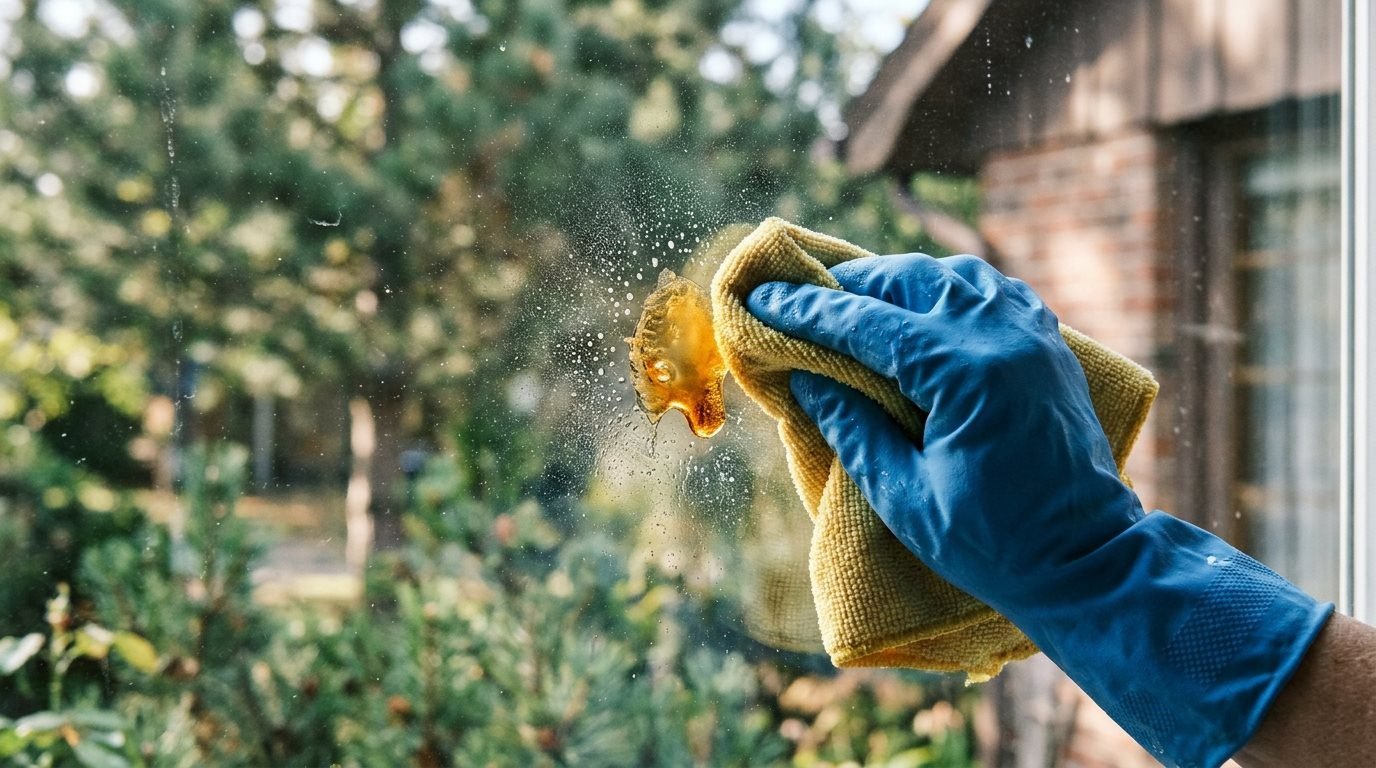
If your home is surrounded by majestic pine, fir, spruce, birch, or maple trees, you know the sinking feeling of looking through your exterior windows and seeing rock-hard amber droplets fused to the glass. Tree sap is nature’s industrial epoxy: sticky when fresh, but once exposed to outdoor air and sunlight, it hardens into an insoluble resinous crust that laughs at standard window sprays.
Frustrated homeowners often make devastating mistakes trying to remove it—attacking the glass with kitchen scrub sponges that leave cloudy swirls of permanent micro-scratches, dragging dry razor blades at steep gouging angles, or spraying harsh industrial paint thinners that melt vinyl window frames and dissolve rubber weatherstripping. Fortunately, with the right organic solvent chemistry and safe blade mechanics, you can dissolve and lift petrified tree sap in under five minutes without leaving a single scratch on your glass.
💡 Direct Answer: How to Remove Tree Sap from Window Glass
To remove tree sap from window glass safely without scratching:
- Wash away surface grit: Sponge the glass with warm soapy water first to remove abrasive wind-blown sand and quartz dust. Never scrape dry glass.
- Apply an alcohol-based solvent: Saturate the sap bead with 91%+ isopropyl rubbing alcohol, or dab a small dollop of alcohol-based hand sanitizer gel directly onto the spot (the gel formulation clings to vertical glass without running).
- Allow a 3-to-5 minute dwell time: Let the solvent break down the sticky terpene resin bonds.
- Scrape at a low 15°–30° angle: For standard untinted glass, push a brand-new single-edge stainless razor blade smoothly forward in one direction with constant liquid lubrication. For tinted or Low-E glass, use a rigid double-edged plastic razor blade.
- Wipe clean with microfiber: Buff the loosened residue away with a clean microfiber cloth dipped in rubbing alcohol, followed by a standard glass cleaner wash.
Dealing with construction adhesive or glass stickers instead of tree resin? Follow our companion guide on how to safely remove paint and stickers from new windows.
The Chemistry: Why Tree Sap Bonds Like Epoxy to Glass
Understanding why ordinary glass cleaners fail on tree sap comes down to fundamental organic chemistry. Conifer tree sap (pine, spruce, fir) is not water-soluble sugar water. It is a complex mixture of terpenes (such as alpha-pinene and limonene), resin acids (primarily abietic acid), and non-volatile esters.
When sap drips onto outdoor glass, exposure to air and UV radiation causes the volatile liquid terpenes to evaporate rapidly. The remaining resin acids undergo oxidative cross-linking, transforming the flexible droplet into a hardened, hydrophobic (water-repelling) amber shell that chemically adheres to the silica ($SiO_2$) surface of glass. Spraying water-based cleaners like Windex or vinegar onto hardened sap is completely ineffective because water cannot penetrate non-polar hydrocarbon resins.
Under the chemical principle of “like dissolves like,” you must use a non-polar or semi-polar organic solvent to dissolve the terpene matrix from the outside in.
Solvent Safety Matrix: What Dissolves Sap vs. What Destroys Window Frames
Not all solvents are safe around modern residential windows. Using the wrong chemical can melt vinyl frames, dissolve rubber glazing gaskets, or ruin expensive Low-E coatings:
| Solvent / Cleaner | Chemical Class | Sap Dissolution Speed | Safety on Glass | Safety on Vinyl & Rubber Gaskets | Verdict |
|---|---|---|---|---|---|
| Isopropyl Alcohol (91%+ or 99%) | Aliphatic Alcohol | Fast (2–3 mins) | 100% Safe | 100% Safe | Top Pick: The undisputed gold standard for residential glass. |
| Alcohol Hand Sanitizer Gel | Ethanol/Isopropanol Gel | Fast (3–5 mins) | 100% Safe | 100% Safe | Best for Vertical Panes: Thick gel doesn’t run down the glass. |
| Mineral Spirits (Odorless) | Petroleum Distillate | Very Fast (1–2 mins) | 100% Safe | Safe (Wipe away quickly) | Best for Petrified Sap: Dissolves thick, years-old amber rock sap. |
| Goo Gone / Citrus Cleaner | D-Limonene (Citrus Terpene) | Moderate (5–8 mins) | 100% Safe | Safe (Wash residue with soap) | Gentle DIY: Pleasant orange scent; requires post-clean degreasing. |
| WD-40 Multi-Use | Petroleum Solvent | Moderate (5 mins) | 100% Safe | Safe on vinyl; keep off rubber | Emergency Alternative: Works well but leaves an oily film. |
| Acetone / Nail Polish Remover | Ketone Solvent | Instant (30 secs) | Safe on bare glass | CATASTROPHIC DANGER | DO NOT USE: Instantly melts vinyl sash frames and dissolves rubber seals. |
| White Vinegar / Windex | Acetic Acid / Ammonia | Zero Effect | 100% Safe | 100% Safe | Useless: Water-based formulas cannot dissolve non-polar resins. |
Metal vs. Plastic Razor Blades: The Anti-Scratch Rules
Looking for the sharpest non-scratch polymer blades for peeling hardened tree sap? Check out our field tests in best plastic razor blade scrapers for glass windows and tint.
Have hard mineral spots caked around tree sap on your car windows? Learn how to safely remove bonded contaminants without peeling tint film in how to remove hard water stains from tinted car windows.
Once the solvent has softened the outer shell of the sap, mechanical lifting is often necessary to pop the droplet off the glass. Choosing the right blade is the difference between pristine crystal glass and thousands of dollars in scratched replacement sashes:
When to Use Single-Edge Stainless Steel Razor Blades
Metal razor blades are safe only on standard, uncoated, untinted annealed or tempered glass, provided you follow four unbreakable professional rules:
- Always Use a Brand-New Blade: Never reuse an old blade from your toolbox. Microscopic burrs, bends, or tiny rust spots on a used blade will act like diamond-tipped glass cutters, gouging deep scratches into the surface.
- Never Scrape Dry Glass: Friction on dry glass causes microscopic glass fabrication debris (micro-fins) to break off and drag under the edge. The glass must always be thoroughly flooded with rubbing alcohol, soapy water, or glass cleaner while scraping.
- Maintain a Low 15° to 30° Angle: Hold the blade as flat to the glass as possible. Never hold a razor blade at an acute 45° or 90° scraping angle.
- Push Forward Only—Never Drag Backward: Push the blade forward into the softened sap. Lift the blade off the glass completely before returning to the start position. Dragging a blade backward traps quartz sand grains under the heel, dragging a trench across the pane.
When to Use Double-Edged Plastic Razor Blades (The Safest Choice)
As detailed in our tutorial on how to remove silicone from glass without scratching, rigid double-edged plastic razor blades (such as Foshio acrylic blades) are engineered from high-density polymer that is stiffer than fingernails but significantly softer than glass. Plastic blades are 100% non-negotiable for:
- Tinted Windows: Aftermarket polyester film scratches instantly under metal. See our guide on cleaning tinted windows safely.
- Surface #1 Low-E Glass: Modern high-performance windows often feature a microscopic pyrolytic Low-E metal coating on the exterior glass face. Metal blades will slice right through it.
- Vinyl Frame Edges: Plastic blades will never gouge your vinyl frame or slice rubber glazing gaskets.
Step-by-Step: The 5-Phase Damage-Free Sap Removal Protocol
Follow this exact professional sequence to remove stubborn dried pine sap without leaving a mark:
Phase 1: Pre-Wash Surface Grit
Never touch a sap droplet on a dirty window. Outdoor glass is coated in wind-blown quartz dust and abrasive sand particles. If you rub a cloth or blade across a dirty pane, you will grind that grit directly into the glass.
- Mix warm water with a few drops of dish soap in a bucket.
- Gently sponge the entire window pane, flushing away loose dirt, dust, and pollen.
- Squeegee or pat dry with a clean microfiber cloth, leaving the raised amber sap droplets clearly visible.
Phase 2: The Hand Sanitizer Gel Dwell Trick
Liquid rubbing alcohol evaporates in 30 seconds on warm glass and runs straight down vertical panes before it can soften hardened resin. Here is the professional secret: use alcohol-based hand sanitizer gel (65% to 75% ethyl or isopropyl alcohol).
- Squeeze a pea-sized dab of hand sanitizer gel directly onto each hardened tree sap bead.
- Because of its thick polymer gel suspension, the alcohol clings directly to the vertical glass without running down the sash.
- Let the gel sit undisturbed for 3 to 5 minutes. The alcohol will soften the cross-linked terpene bonds, turning the rock-hard amber bead into a soft, jelly-like paste.
Phase 3: Lubricated Precision Scraping
Once the sap has softened to a pliable jelly consistency, mechanical removal is effortless:
- Spray a light mist of 91% rubbing alcohol or soapy water over the area to ensure continuous liquid lubrication.
- Hold your new stainless steel blade (or plastic razor) at a shallow 20-degree angle to the glass.
- Push smoothly forward into the base of the softened sap bead. The droplet will slice clean off the glass in a single effortless pass.
- Wipe the gooey residue off the blade onto a paper towel before starting the next spot.
Phase 4: Dissolving the Ghost Ring Haze
After lifting the main droplet, tree sap almost always leaves behind a sticky, cloudy “ghost ring” of micro-resin bonded to the glass pores.
- Fold a plush microfiber towel into quarters and saturate a corner with straight 91% or 99% isopropyl alcohol.
- Rub the ghost ring in firm, small circular motions for 15 seconds. The high-proof alcohol will liquefy the residual resin film instantly.
- Flip to a dry, clean section of the microfiber cloth and buff the glass completely clear.
Phase 5: Final Glass Polish & Frame Inspection
Finish by cleaning the entire window with your regular glass cleaner to restore a uniform streak-free sheen. Inspect the lower window track and sash: if sticky sap or pine needles have dropped into the channel, clear them out and lubricate the track as outlined in our guide on cleaning and maintaining metal window tracks.
Special Scenarios: Tree Sap on High Windows & Skylights
Overhanging pine and evergreen branches frequently drop sap onto second-story bedroom windows and slanted roof skylights where handheld razor blades cannot reach without dangerous ladder climbing.
In our in-depth review of the best telescopic window cleaning poles for high windows, we recommend attaching an extension pole glass scraper equipped with an angled safety cone. Saturate an extension washer wand in a 50/50 mix of warm water and isopropyl alcohol to pre-soften the high-reach sap, then make gentle, low-angle upward passes with the pole scraper to release the resin safely from the ground.
Dealing with stubborn circular rings or foggy residue left behind by window bird feeders or holiday hooks? Read our step-by-step chemical breakdown on how to remove suction cup marks from glass windows without hazing.
Frequently Asked Questions (FAQ)
Can white vinegar remove dried tree sap from window glass?
No. White vinegar is a 5% aqueous solution of acetic acid. Tree sap is an organic terpene resin that is hydrophobic (oil-soluble), not water-soluble or acid-soluble. Vinegar will bead up on hardened sap without softening or dissolving it. You must use an organic alcohol (like isopropyl alcohol), citrus terpenes (Goo Gone), or mineral spirits to break down the resin bonds.
Will tree sap permanently damage or etch window glass if left alone?
Yes. While glass is chemically resilient, tree sap contains organic abietic and tannic acids. When baked by intense summer sunlight or left through freezing winter cycles, the sap shrinks and expands, pulling on the silica surface. Over 6 to 12 months, this can cause microscopic pitting and permanent chemical etching that looks like cloudy water spots even after the sap is removed.
Can I use acetone (nail polish remover) to clean sap off my windows?
While acetone dissolves tree sap very quickly and is technically safe on pure glass, it is extremely hazardous to use around modern residential windows. If even a tiny drip of acetone runs down the pane onto vinyl sash frames, it will chemically melt and blister the plastic permanently. Acetone also destroys rubber glazing gaskets and strips automotive/residential paint. Stick with 91% isopropyl alcohol, which is 100% safe on glass, vinyl, and rubber.
How do I remove tree sap from vinyl window frames without damaging the finish?
To clean tree sap off vinyl frames without melting the PVC or stripping the color: dab a microfiber cloth with 70% isopropyl alcohol or a small drop of cooking vegetable oil. Rub gently in circular motions until the sap softens, then wash clean with warm water and Dawn dish soap. Never use acetone, lacquer thinner, or metal razor blades on vinyl window frames.